
Writing Guidelines
1. Introduction
The introduction section plays a critical role in framing the manuscript within its scientific and philosophical context. It should:
- Clearly establish the research context and the broader academic landscape
- Identify a specific, well-defined gap in the existing literature
- Articulate the original contribution of the study
- Provide a logical progression from general background to a focused research problem
A well-written introduction should guide the reader seamlessly from a broad conceptual framework to a precise and clearly articulated research question. It should not merely describe the topic, but critically situate the study within ongoing scholarly debates.
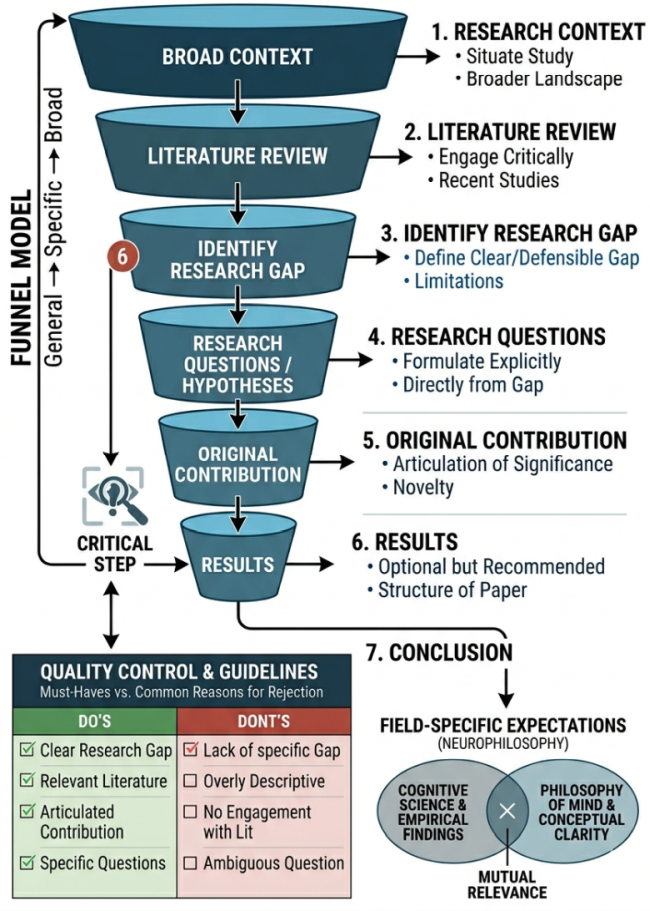
2. Structure of a Strong Introduction
2.1 Research Context
The introduction should begin by situating the study within a broader theoretical and/or empirical framework. Authors are expected to:
- Provide a concise yet meaningful overview of the research area
- Introduce and define key concepts, especially if they are interdisciplinary or contested
- Establish the relevance and significance of the topic within the field of neurophilosophy or related disciplines
- Avoid excessive generalization or overly broad historical summaries
The goal of this section is not to exhaustively review the field, but to orient the reader and prepare the ground for identifying the research problem.
2.2 Problem Statement and Research Gap
A central requirement of the introduction is the explicit identification of a clear and defensible research gap. Authors should:
- Critically engage with relevant and recent literature
- Highlight limitations, contradictions, or unresolved issues in existing studies
- Demonstrate why the current state of knowledge is insufficient
- Clearly articulate what has not yet been addressed in the literature
Introductions that are vague, overly descriptive, or fail to identify a precise research gap will not meet the journal’s standards and may be rejected without review.
The research gap must be:
- Specific
- Justified by literature
- Directly connected to the study’s objectives
2.3 Research Questions or Hypotheses
The introduction must clearly present the intellectual direction of the study by stating:
- The primary research question(s)
- Any relevant hypotheses or theoretical propositions
These should:
- Be explicitly formulated
- Directly emerge from the identified research gap
- Be logically connected to the study’s aims and methodology
Ambiguous or implicit research questions weaken the overall coherence of the manuscript and are strongly discouraged.
2.4 Contribution of the Study
Authors must clearly and explicitly state the original contribution of their work. This section is essential for evaluating the significance and novelty of the manuscript.
Contributions may include:
- Theoretical contributions (e.g., new conceptual frameworks, reinterpretations of existing theories)
- Methodological contributions (e.g., novel approaches, analytical techniques)
- Empirical contributions (e.g., new data, experimental findings, case studies)
- Interdisciplinary contributions (e.g., bridging neuroscience and philosophy)
The contribution must:
- Be clearly distinguishable from prior work
- Be directly linked to the research gap
- Be articulated in a precise and non-exaggerated manner
2.5 Scope and Structure of the Paper (Optional but Recommended)
At the end of the introduction, authors may include a brief outline of the manuscript. This section should:
- Provide a clear roadmap of the paper
- Briefly describe the purpose of each subsequent section
- Help readers understand the logical organization of the work
This section should remain concise and should not duplicate content from later sections.
3. Style and Clarity Requirements
To ensure clarity, rigor, and readability, authors should adhere to the following principles:
- The introduction must be clear, concise, and focused
- Avoid unnecessary or overly detailed background information
- Do not include results, discussions, or conclusions
- Use precise, formal, and academic language
- Ensure logical flow and coherence between paragraphs
- Avoid ambiguity, redundancy, and unsupported claims
Each paragraph should serve a clear purpose in building toward the research problem and its resolution.
4. Common Reasons for Rejection
Manuscripts may be desk rejected or returned for revision if the introduction exhibits one or more of the following issues:
- Failure to clearly define a research gap
- Lack of a clearly articulated research question or hypothesis
- Insufficient engagement with relevant and recent literature
- Overly descriptive or narrative writing without critical analysis
- Weak or unclear statement of the study’s contribution
- Poor logical structure or lack of coherence
- Misalignment with the scope of the journal
Authors are strongly encouraged to critically evaluate their introduction before submission to ensure it meets these standards.
5. Field-Specific Expectations (Neurophilosophy)
Given the interdisciplinary nature of neurophilosophy, introductions should:
- Integrate philosophical argumentation with empirical findings from neuroscience
- Address both conceptual clarity and scientific relevance
- Situate the study at the intersection of philosophy of mind, cognitive science, and neuroscience
- Demonstrate awareness of both theoretical debates and empirical methodologies
Authors should avoid treating philosophy and neuroscience as separate domains; instead, the introduction should reflect their mutual relevance and interaction.
6. Recommendation for Authors
For optimal clarity and academic quality, authors are encouraged to structure their introduction as follows:
- Broad Context
Introduce the general topic and its relevance to the field - Critical Literature Review
Summarize and evaluate key studies, identifying limitations or gaps - Identification of Research Gap
Clearly state what is missing or unresolved in the current literature - Research Questions or Hypotheses
Present the central aims of the study in a precise manner - Statement of Contribution
Explain how the study advances knowledge in the field - Optional: Structure of the Paper
Provide a brief overview of the organization of the manuscript
```


