This paper proposes a novel medical device for the psychotherapeutic treatment of outpatient drug-addicts. The device has a wearable EEG recording headset and a synchronously working, necklace-held medallion for collecting audiovisual data on the patient's environment and social interactions while also allowing two-way device-patient communications. The objective of the system is threefold. First, it extends the patient's typically short daily psychotherapeutic treatment for all waking hours. Second, it helps to activate the protective mechanisms of the patient's Soul. The two-way communication system of the device can specifically generate the "illuminating vision" for the user that lets his or her Soul's Will initiate the final hard steps toward full and permanent freedom from drugs. The third objective is that however the device's absolutely private use is done with internet-free data exchanges with a USB flash drive, once the treatment is completed the device assists in the creation of a worldwide community of former users to help other addicts.
Introduction
According to World Drug Report 2026 by the United Nations Office of Drugs and Crime, available at: https://www.unodc.org/unodc/en/data-and-analysis/world-drug-report-2026.html, "An estimated 331 million people used drugs in 2024, a 34 percent increase since 2014..." The document emphasizes that young people are particularly exposed to the high-risk use of not just cocaine and heroin but also to methamphetamine and the increasing number of new synthetic psychoactive substances. All of these compounds are highly addictive and the UN Report calls to combine "public health, justice and security approaches... to reduce harm, save lives and build safer, healthier and more resilient societies." In the United States alone, the National Center for Drug Abuse Statistics recorded 1.15 million deaths due to overdose of addicted drugs since 1999 (see https://drugabusestatistics.org/). In fact, the above sad numbers are expected to increase because the addictive use of marijuana, now a multibillion-dollar legal business in the United States despite its adverse cognitive effects (Volkow et al., 2014), is often the gateway to other addictive drugs like opioids (Olfson et al., 2018) and harmful psychoactive substances like LSD and PCP (Desai et al., 2022).
The present cosmological neuroscience paper addresses the problem of public health in reducing drug addiction. Specifically, the paper suggests the use of a novel, wearable medical device for expanding the psychotherapeutic treatment of drug-addicts to all waking hours and inspiring their affected Soul's own pro-recovery protective mechanisms.
The view of cosmological neuroscience on drug addiction
Cosmological neuroscience is a new, interdisciplinary field of neurophilosophy. This new field, described in several papers by this author (Ludvig, 2022a,b; 2023; 2024; 2026a,b) aims to study the nervous system in the context of cosmic laws, including the laws that made life on Earth possible and let it evolve to generate the nervous system and its increasingly more complex forms culminating into the appearance of the human Soul.
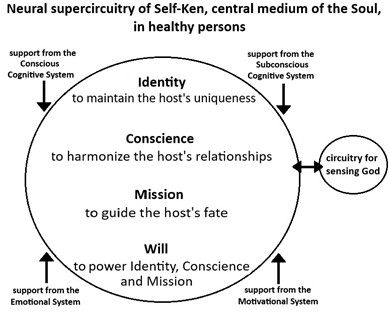
The Soul itself is defined by cosmological neuroscience as a product of matter and energy in special nodes of space-time where the guided structural and dynamic complexity of the involved substances reaches such a high level that a distinct presence is born, the presence of Soul: neither matter nor energy yet inseparable from each while equips the meaning of both with purpose and the potential to transcend. While this concept views Soul as a cosmically guided evolutionary product appearing in the neural environment of consciousness in the highly developed phyla of the animal kingdom, the concept acknowledges the giant leap of this evolution in the hominin line, leading to not just to the uniquely developed prefrontal cortical supercircuitry of the human Soul with the Self-Ken as its central medium but also its associated circuitry of sensing God (Figure 1).
Specifically, Self-Ken is considered as the human-specific neural system with four interacting domains that represent the host's Identity, Conscience, Mission and Will. The presence of an associated God-sensing neural circuitry is supported as much by the psychological examples of geniuses from Jesus and Muhammad through Michelangelo and Teilhard de Chardin to Blaise Pascal and Sir John Eccles as by the millions of deeply and genuinely religious men and women on the planet. Indeed, it is this God-sensing circuitry that seems to connect the human Soul to Nature's higher systems of Soul felt by Spinoza (see Winston, 1987), Alfred Russel Wallace (Wallace, 1889), Teilhard de Chardin (Teilhard de Chardin, 1959) and some others.
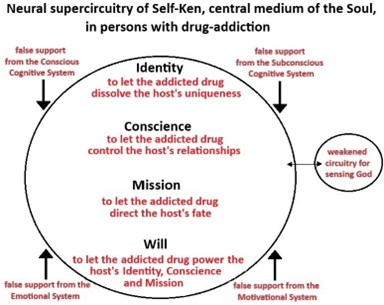
The cosmological neuroscientist views drug-addiction as a reversible dysfunction of Self-Ken. Specifically, this dysfunction is viewed as the manifestation of a deformed Self-Ken that (a) lets the addicted drug alter the Self-Ken's Identity domain by dissolving the host's unique personality; (b) lets the addicted drug alter the Conscience domain by controlling the host's social relationships; (c) lets the addicted drug alter the Mission domain by directing, however reversibly, the host's fate; and (d) lets the addicted drug alter the Will domain by forcing it to power the host's deformed Self-Ken under false cognitive, emotional and motivational influences and a weakened circuitry for sensing God [Figure 2].
This view of cosmological neuroscience is not in contradiction with the DSM-5-TR description of Substance Use Disorders (American Psychiatric Association, 2022) as a psychiatric condition characterized by (a) loss of control over the taking of one or more chemical substances, (b) impaired social and interpersonal relationships, (c) recurrent drug use in risky and physically unsafe environments, and (d) living with such harmful consequences on health as tolerance, requiring ever increasing doses of the abused drugs, and severe withdrawal symptoms when the drugs are not used. In fact, the author's cosmological neuroscientific view is not in contradiction with the opinions of some higher-minded intellectuals either (Table 1).
| Intellectuals | Opinion | Reference |
|---|---|---|
| Abdu'l Baha (1844–1921) | "For opium fastens the soul, so that the user's conscience dies, his mind is blotted away, his perceptions are eroded." | (see Abdu'l Baha, 1982; originally published in Parsi in his lifetime) |
| Aleister Crowley (1875–1947) | "The danger of the so-called habit-forming drugs is that they fool you into trying to dodge the toll essential to spiritual and intellectual development." | (Crowley, 1922) |
| Carl Jung (1875–1961) | "I was very careful when I talked to Rowland H... His craving for alcohol was the equivalent, on a low level, of the spiritual thirst of our being for wholeness... the union with God." | (see Schoen, 2009) |
| Jean Cocteau (1889–1963) | "Opium becomes serious to the extent to which it affects the nerve centers which control the soul." | (Cocteau, 1957; originally published in French in 1930) |
| Gerald G. May (1940–2005) | "The objects of our addiction become our false gods. These are what we worship, what we attend to, where we give our time and energy, instead of love. Addiction, then, displaces and supplants God's love as the source and object of our deepest true desire." | (May, 1991) |
The concept of Soul is not in the mainstream of current neuroscience, even though Nobel laureate Francis Crick himself gave this title to his 1994 neuroscientific book: "The Astonishing Hypothesis: The Scientific Search for the Soul". But Heisenberg was probably right when he wrote in his own 1971 book, Physics and Beyond, that "In science... it is impossible to open up new territory unless one is prepared to leave the ... anchorage of established doctrine." So the concept of Soul may well be revisited in the future.
As for Self-Ken, the proposed central medium of the human Soul, most of its domains have been well studied. Identity, though viewed as Ego, was examined by Freud (Freud, 1927), Conscience was the subject of the landmark book of Churchland (Churchland, 2019), and Will was described in the classic 1818 opus of Schopenhauer: "The World as Will and Representations". Cosmological neuroscience just integrated these mostly separately seen neural functions into a coherent whole - with the modifications this act needed. Just as architecture integrates - with its own modifications - design ("Identity"), community role ("Conscience") and engineering capital ("Will") into a useful building. The Soul's not yet fully understood Mission domain seems to be a partly genetically and partly environmentally determined neural function (Ludvig, 2022b) that equips "the Soul's host with the purpose of his or her existence and potential to transcend so that his or her destiny, good or bad, can be accomplished if undertaken, whether or not its meaning is understood by him/her or the surrounding society."
The multiple ways drug-addiction disturbs the Soul are indicated on Figure 2. That the disease attacks Identity by "dissolving the host's uniqueness" is reflected in the blending of the abuser's personality into the common features of craving and seeking for drugs so similar - in essence - in the millions of drug addicts. That Conscience is affected, letting the addicted drug darken the patients' human relationships, is proven by the frequent violence, crime, destroyed marriages and workplace conflicts associated with the disease. And what was behind tragic fates of such extraordinary artists as Brian Jones, Jim Morrison, Jimi Hendrix, Janis Joplin, Kurt Cobain or Amy Winehouse if not the replacement of their music- and poetry-blessed Mission with the "false gods" Gerald May referred to (Table 1)? Indeed, it is the drug-manipulated Will of the patients' Soul that powers all the mental dysfunctions of the drug-addicts' life - until the right, medical or non-medical, therapy is found and chosen.
The problem of psychotherapeutic approaches for outpatient drug addicts
Psychotherapeutic/psychosocial treatments, including cognitive-behavioral therapy, relapse prevention, motivational enhancement, Twelve-Step-Facilitation and similar approaches combined with pharmacotherapy (Ray et al., 2020; Jianjee, 2024), help people with Substance Use Disorder to recover from their addiction. This proves the admirable progress of psychiatry in the last few decades. Still, about 40-60% of the treated patients remain resistant to these therapies and unable to reach abstinence (Marel et al., 2019; Wells et al., 2024).
This paper argues that the current therapies for drug-addiction fail to treat all patients effectively because the standard psychotherapeutic/psychosocial outpatient care uses treatment sessions lasting maximum a few hours per day. This leaves the patient without therapeutic guidance for the rest of his/her waking hours until the next session in the week. But these intersession periods are not free of the risky environmental and social conditions that led to the patient's drug-addiction in the first place.
It is also argued here that current therapies for drug-addiction may not activate effectively the Soul's own pro-recovery protective mechanisms through the associated circuitry for sensing God (Figure 1). True, even the National Institute on Drug Abuse concluded in one of its comprehensive studies that "... the finding that a stronger belief in religiosity/spirituality significantly reduces relapse from drugs of abuse has clinical relevance." (Schoenthaler et al., 2015). Yet, the limited time-frames of psychotherapeutic outpatient care for drug addicts cannot provide the best conditions for every patient to activate his or her Soul's divine protective mechanisms.
Is there evidence for such protective mechanisms? Every reader of this paper can find the answer by asking a friend with Substance Use Disorder: "Would you like to live a life without depending on your drugs, be suddenly free to do what you always really wanted to do?" Their "yes", though likely whispered, cannot come from other place than their circuitry for sensing God, guarding - unthanked, unrecognized - who they really are in their deepest depth. One of the Reviewers of this paper nevertheless disagreed, suggesting that such an answer can also be "fully explicable in ordinary motivational and existential terms". While this is a justified criticism, one may consider that in the very depth of our "ordinary" mental responses there are often spiritual determinants we do not realize yet move those responses. When we talk to a priest or rabbi, our behavior carries "ordinary" politeness - yet this ordinary act may really be governed by sensing some divine presence.
The need for daylong psychotherapeutic guidance activating the Soul's protective mechanisms for outpatient drug-addicts
Just as patients with diabetes or hypertension need their doctor-recommended daylong self-care for keeping their blood glucose levels or blood pressure counts, respectively, within the right range, outpatient drug-addicts also need their psychotherapy-driven self-care for all waking hours to keep their pro-recovery effort on the right track. How to do it?
Daylong interaction with the addict's therapist is not a realistic way because every therapist surely works on other cases too, forbidding attention to a single patient. Sure, the option of residential treatment is there for everyone - yet this is also problematic because not every drug-addict prefers to give up his or her private life full of studies and entertainment, sport and meetings, family and love. Indeed, there must have been reasons for Amy Winehouse to sing that "...They tried to make me go to rehab, but I said, No, no, no". According to a relevant opinion (Fitzpatrick, 2011), "Amy, who could afford the best private clinics, did subsequently enter (and re-enter) rehab. The grim failure of this strategy, recorded in prurient detail in the tabloids, culminated in her death."
To avoid misunderstanding of the previous paragraph, I add that residential treatment has been proved to be successful for many drug addicts. Eric Clapton, a recovered heroin- and cocaine-addict, himself said about the residential addiction recovery facility, Crossroads Centre Antigua, he founded: "I could never have made it without the kind of treatment that we offer here" (see https://crossroadsantigua.org/). Though this effective residential treatment version is not available or affordable to everybody - while they also count.
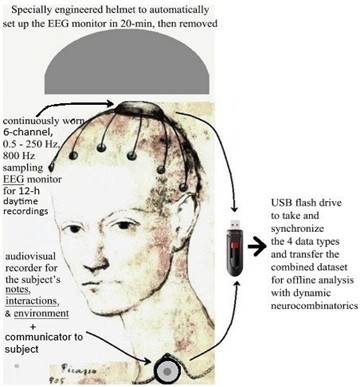
A possible method for accessing wide-range psychotherapy in all waking hours is proposed in the next section. It applies a wearable device with hardware based on our EEG- and behavior-monitoring diagnostic headset (Ludvig et al., 2011) and software using dynamic neurocombinatorics for EEG analysis (Ludvig, 2026a) and a special program for intelligent two-way interactions between patient and device (Figure 3).
A wearable device for daylong psychotherapeutic help for outpatient drug-addicts
The essence of the method, visualized in the figure below, is that:
1) It has a wearable EEG system made to be set up by the user at home in the morning and removed also by him or her before bedtime with a specially engineered helmet, allowing the best privacy for this method. While this helmet has yet to be developed to integrate an AI-driven electrode-placing/electrode-removing mechanism, the artifact-free EEG recording system of this wearable system has been described for our patented, seizure-detecting headset (Ludvig et al., 2011).
2) The offline analysis of the EEG data uses dynamic neurocombinatorics to recognize – after a 2-month learning period in the patient's life – the subconscious signs of the abusive circumstances to be avoided and the pro-recovery ones to be sought. Though not in full details to prevent abuse and plagiarism, the basics of dynamic neurocombinatorics has been described (Ludvig, 2026a) as follows: "This offline analysis method would characterize each and every EEG wave with a code of its complexity by measuring with 2 msec resolution (1) the wave's peak amplitude, (2) its duration, (3) the angles of its rising and falling phases, and (4) its superimposition with other wave frequencies, while adding to each wave the codes of the host's environment (room, street, workplace, etc.) and his or her behavior (sleep, working, talking, etc.) during the wave – all along the continuous recordings," which can be full daylong recordings (Ludvig, 2026a). The author believes this novel EEG analysis will be able to identify the electrophysiological signs of both abusive circumstances and pro-recovery environments in drug-addicts.
3) This EEG system – using unipolar recordings limited to the disease-involving prefrontal cortex – works synchronously with a necklace-held medallion audiovisually communicating with the user. This communication includes warning when a risky environment is encountered and confirming the presence of a helpful one. Some other, wide-range functions of the medallion are indicated in Figure 4. Obviously, this system requires regular checking and patient-specific modifications by the patient's physician, the only authorized trained user of the USB flash-drive that collects the EEG and behavioral data.
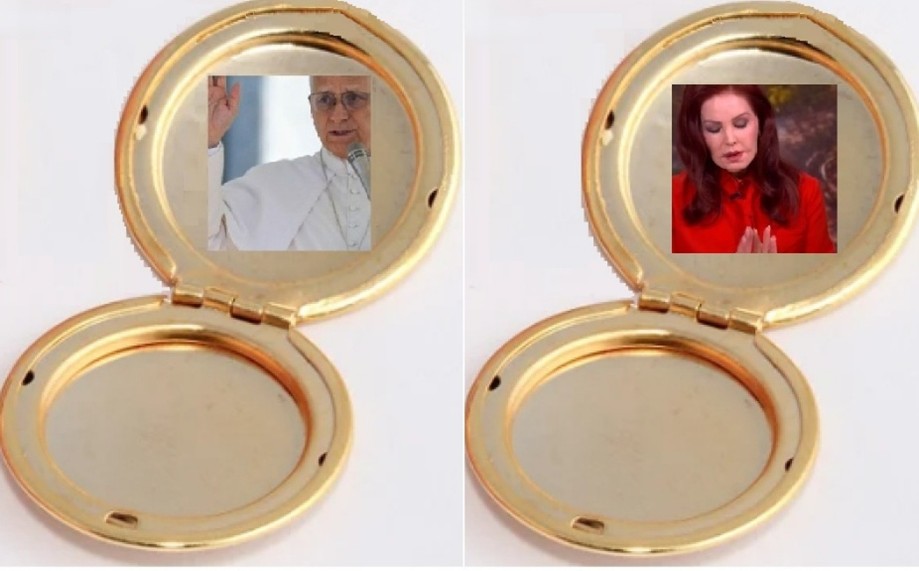
Obviously, the examples of Figure 4 are just two examples for this paper, as the patients' most loved family members, best friends, admired teachers, trusted therapists and favorite artists can also interact with them from the medallion's screen - though only when really needed. Crucially, this is a private intelligent system envisioned as doing nothing with the internet and its current commercial AIs such as ChatGPT, Meta AI, Gemini, Claude or Grok. The reason is the characteristic ambiguity of current AI interactions - as explained below.
To test whether current AI models are able to give unambiguous solutions to a medical problem this author asked Gemini AI the following question: Do the spread of legalization and commercialization of marijuana use in the United States improve education and health of the people? The AI answer was that "While legalization has brought some major benefits like fewer arrests and new tax money, it has also brought new problems like more hospital visits and mixed effects on learning." Science can gain from this ambiguity, prompting further, more accurate studies. But the lack of clearly warning the social danger of this new marijuana policy makes the quoted AI response confusing, justifying the development of a new intelligent software for the described pro-recovery device.
Since meaningful recovery from drug-addiction is difficult to achieve without spiritual help, the medallion would also remind the patient in some contemplative moments of the majesty of the world despite the presence of evil: this tempter of him or her to be sent away - just as Jesus, Siddhartha Gautama the Buddha and Muhammad sent away theirs.
Illuminating the highest and lowest points of the drug-addict's life: key to recovery
In a recent paper this author argued that the life-changing experiences of such religious figures, inventors and artists as St. Paul, Joan of Arc, Muhammad, Nikola Tesla, Arundhati Roy and others were likely the results of a dramatic "illuminating vision" generated by emotionally hypercharged and motivationally significant neural streams emanating from their Soul (Ludvig, 2026b). The severe drug-addict may need to experience a similar "illuminating vision" for gaining the Will for full and permanent recovery - even if this vision would serve just a single life instead of the course of history, as equally important they are. The described headset-medallion system should help its user to go through such an experience by recognizing that he or she "hit the rock bottom" in his or her life, communicating it to him or her as a message from the most special loved one, and contrasting it with the highest point of his or her life to induce the mental tension able to release the life-changing "illuminating vision" of recovery.
The stage of "rock bottom" in life can be recognized by the device's environment-recording and subconscious-screening video/EEG technology not missing the drug-addict patient's synchronous verbal confirmation when being in the middle of this stage.
The highest point in the drug-addict's life can be represented in the device's memory as a verbal/audiovisual file created by the patient and his or her collaborating psychotherapist specifically for the purpose of facilitating recovery.
The illuminating vision, should it follow the drug addict's experienced "rock bottom" and its device-run contrasting with the best moment in his or her life, would then be the cornerstone of this novel psychotherapeutic course toward achieving recovery and abstinence.
Discussion
The cosmological neuroscientist is not naive to think that Substance Use Disorder is merely a medical problem that can be solved without a just global society obliged to give everyone, including its potential drug-dealers and drug-addicts, the chance of a meaningful life. But in the meantime, the victims of drug-dealing must be helped.
This paper proposed a novel medical device for the psychotherapeutic treatment of outpatient drug addicts. The proposal does not intend to replace existing outpatient psychotherapies for people with Substance Use Disorder, rather, it intends to expand those treatments for all waking hours while also increasing the treatments' spiritual content. This new strategy is not for all outpatient drug addicts, just for those who wouldn't mind wearing the headset-medallion units throughout daytime for months. But even the most conservative estimates for their number yield tens of thousands of patients worldwide.
The device combines prefrontal cortical EEG recording with audiovisual data collection to generate not just the naturally complex set of information on the patient's condition but also to allow the critical two-way communication between device and user. This two-way communication has the potential to generate the "illuminating vision" for the user that let his or her Will to initiate the final steps toward full and permanent freedom from harmful drugs.
The idea that the completion of this device-assisted psychotherapy would be followed by creating a worldwide community of its former users to help other addicts is supported by the observation of Malcolm X, who was himself a recovered drug addict, about the phenomenal success of people like him receiving help from a community of new friends all freed from substance abuse (Haley, 2015). Obviously, the novel therapeutic strategy described in this paper for Substance Use Disorder will also require a new mindset for psychiatrists, the philosophy that excelling with knowledge on the science of brain disorders, understanding the multiscale phenomenon of Soul and using the power of beneficial technologies for psychotherapy are not parts of different worlds but integral components of the 21st century psychiatric practice.
Reviewers of this paper raised two important concerns about the device that must be addressed here.
The first concern was a legal one, about the problem of the device's potential to "record criminal activity". This can be solved only with legal consultation beyond this author's expertise. Because any criminal recording with the audiovisual medallion of the device is also an intrusion into the privacy of the recorded people. Nevertheless, since cosmological neuroscience believes in the duty of help before the action of punishment, this author thinks that recording criminal activity with the device of Figure 3 must follow first with letting a third party inform the involved criminals about the proof of their wrongdoing and the available remedy for that wrongdoing without the inclusion of law enforcement. In case of the rejection of this offer, the now justified involvement of law enforcement is organized by the involved third party – without causing any inconvenience to the patient and his/her physician.
The second concern was a scientific one, about the risk of "triggering psychiatric crisis" with the illuminating vision helped by the device, however unintended that triggering effect was. The only solution of this potential problem is to do the proposed methodology right, with the involved psychiatrists spending every effort to (1) understand the specific causes that led to the patient's drug addiction, (2) understand the patient's specific social and cultural upbringing and mindset, (3) understand the risks and benefits of the device-therapy for the treated drug-addict, and (4) use their highest creativity to develop accordingly, in collaboration with the patient, the proper, patient-specific software for the medallion to make sure it conveys only safe messages to the patient. However, it must be the conscientious use of the device and the highest-quality analyses of the results of this device-assisted psychotherapy that would ultimately guarantee the prevention of any psychiatric crisis for every drug-addicted patient.
Conclusions
A wearable EEG-, environment-, and behavior-monitoring interactive device for drug-addicted persons to intelligently expand their pro-recovery psychotherapeutic guidance for all waking hours and help the divine protective mechanisms of their Soul might be one of the new, safe and effective, therapies for Substance Use Disorder.
Conflict of Interest
None
Statement on AI use
This paper was conceived, structured, and its every sentence written up by this author except the included quotations indicated with quotation marks. Consistent with the digitally enhanced complex thinking of cosmological neuroscience, the paper's database was compiled with the use of personal collections, physical library materials and data accessed via both regular and AI-assisted Google searches.
References
- Abdu'l Baha. Selections from the Writings of Abdu'l Baha. Baha'i World Centre, Akka and Haifa, 1982.
- American Psychiatric Association. Diagnostic and statistical manual of mental disorders (5th ed., text rev.), 2022.
- Churchland PS. Conscience: The Origins of Moral Intuition. W.W. Norton & Company, New York, 2019.
- Cocteau J. Opium: The Illustrated Diary of his Cure. Peter Owen Publishers, London, 1957.
- Crowley A. The Diary of a Drug Fiend. W. Collins Sons & Co., London, 1922.
- Desai S, Kulkarni N, Gandhi K, You XX & Gerolemou DO. The link between marijuana and hallucinogen use among US adolescents. Prim Care Companion CNS Disord 2022; 24(5): 21br03204.
- Fitzpatrick M. Why Amy was right about rehab. Br J Gen Pract 2011; 61: 574.
- Freud S. The Ego and the Id. The Hogarth Press, London, 1927.
- Haley A. The Autobiography of Malcolm X. Ballantine Books, New York, 2015.
- Jhanjee S. Evidence based psychosocial interventions in substance abuse. Indian J Psychol Med 2024; 36: 112-118.
- Ludvig N, Medveczky G, Kuzniecky RI, Illes G & Devinsky O. System and Device for Seizure Detection. US Patent No. 7,885,706, issued in 2011.
- Ludvig N. A cosmological neuroscientific approach to the Soul of Multiverse. Open J Philos 2022a; 12:460-473.
- Ludvig N. The Identity, Conscience, Will and Mission domains of Soul across Human, Noospheric and Cosmic scales. Open J Philos 2022b; 12:580-600.
- Ludvig N. A cosmological neuroscientific definition of God. Open J Philos 2023; 13: 418-434.
- Ludvig N. Cosmological neuroscience on the relationship between the evolutionary levels of Consciousness and the multidimensional nature of Soul. JNphi 2024; 3: 88-95.
- Ludvig N. Potential contributions of cosmological neuroscience to the future of brain research. J Psychol Neurosci 2026a; 8: 1-8.
- Ludvig N. St. Paul's illuminating vision protected by the non-Christian Jewish King Agrippa II to make the spread of Christianity possible. JNphi 2026b; 5: 218-228.
- Marel C, Mills KL, Slade T, Darke S, Ross J & Teesson M. Modelling long-term trajectories of heroin use and treatment utilization: Findings from the Australian Treatment Outcome Study. EClinicalMedicine 2019; 14: 71-79.
- May GG. Addiction and Grace. HarperCollins Publishers, San Francisco, 1991.
- Olfson M, Wall MM, Liu S-M & Blanco C. Cannabis use and risk of prescription opioid use disorder in the United States. Am J Psychiatry 2018; 175: 47-53.
- Ray LA, Meredith LR, Kiluk BD, Walthers J, Carroll KM & Magill M. Combined pharmacotherapy and cognitive behavioral therapy for adults with alcohol or substance abuse disorders. A systematic review and meta-analysis. JAMA Network Open 2020; 3:e208279.
- Schoen DE. War of the Gods in Addiction: C.G. Jung, Alcoholics Anonymous, and Archetypal Evil. Chiron Publications, Asheville, 2020.
- Schoenthaler SJ, Blum K, Braverman ER, Giordano J, Thompson B, Oscar-Berman M et al. NIDA-Drug Addiction Treatment Outcome Study (DATOS) relapse as a function of spirituality/religiosity. J Reward Defc Syndr 2015; 1:36-45.
- Teilhard de Chardin P. The Phenomenon of Man. Harper & Brothers, New York, 1959.
- Volkow ND, Baler RD, Compton WM & Weiss SRB. Adverse health effects of marijuana use. N Engl J Med 2014; 370:2219-2227.
- Wallace AR. Darwinism: An Exposition of the Theory of Natural Selection with Some of Its Applications. Macmillan and Co., London, 1889.
- Wells M, Kelly P, Robson D, Haynes C, Hatton E & Larance B. Systematic review of treatment completion rates and correlates among young people accessing alcohol and other treatment. Drug Alcohol Depend 2024; 262: 111376.
- Winston D. Spinoza, Baruch. M. Eliade (Ed.), The Encyclopedia of Religion (Vol. 14), Macmillan Publishing Company, New York, 1987.
Authors hold copyright with no restrictions. This work is licensed under CC BY.
- A novel wearable device combining EEG and audiovisual monitoring is proposed to extend psychotherapy for outpatient drug addicts to all waking hours.
- The device aims to activate the Soul's pro-recovery mechanisms through an "illuminating vision" that strengthens the Will to overcome addiction.
- Current outpatient psychotherapies are limited to a few hours per day, leaving patients without guidance during risky intersession periods.
- Cosmological neuroscience views drug addiction as a reversible dysfunction of Self-Ken, affecting Identity, Conscience, Mission, and Will.
- The device includes a necklace-held medallion for two-way communication, providing warnings about risky environments and confirmations of helpful ones.
- Data is stored offline on a USB flash drive to ensure absolute privacy and to prevent data loss.
- The system uses dynamic neurocombinatorics for offline EEG analysis to identify subconscious signs of abusive and pro-recovery circumstances.
- The "illuminating vision" is facilitated by contrasting the patient's "rock bottom" experience with their highest life moment to induce lasting recovery motivation.
- Upon treatment completion, the device helps create a worldwide community of former users to support other addicts.
- Legal and scientific concerns about recording criminal activity and triggering psychiatric crises are addressed through careful, patient-specific protocols.