There is continuity between truth and the relevant objective things in reality, and its intrinsic mechanism is inertia. Inertia is an inherent characteristic of objective things, and truth resides there. Inertia generates continuity, which is a necessary condition for reasoning. It can go from the quantitative change of real space all the way deep into the qualitative change of the ideal realm, and expand the philosophical view of materialism to the category of metaphysics. In the fundamental part of Eastern and Western philosophy, this absence has been for more than two thousand years. From this, it can be seen that the law of the unity of opposites should have been Trialism. In fact, we use it every day, yet do not reflect on it deliberately. Once a consensus is reached, it means the unification of Eastern and Western philosophies. Based on this, the norms for identifying truth are given, and the true nature of metaphysics is restored through norms and definitions. In addition, the definition of philosophy is discussed and given. The Trialism on things' limits is founded, which resolves the dilemma that truth has no place in Dualism, and thereby uses this theory to perfect materialism as well as the unity of opposites of all knowledge.
Introduction
I am over seventy years old, and looking back on this life, the highlight has lain in discovering that there is continuity between truth and the relevant objective things in reality, and its intrinsic mechanism is inertia. Rather than saying that this is a major discovery in the field of ideology in more than two thousand years, it is better to say that people use it every day, just without deliberately reflecting on it. This discovery reveals the true nature of metaphysics by means of scientific methods, proves that truth resides therein and that there is continuity between it and relevant objective things in reality, and thus expands the philosophical view of materialism to the category of metaphysics, which can be regarded as a rebirth of philosophy.
The words and deeds of previous sages
In April 2024, my wife and I went on a trip to Zhangjiajie, and first passed through Changsha to Shaoshan to pay a visit with reverence to the former residence of Chairman Mao Zedong. In the exhibition area of Chairman Mao's bedroom, I saw a "catalog of books to bring when going out", which included "Yang Xianzhen's philosophical works". It reflected their relationship as good mentors and friends who could talk straight in philosophical research. It is recalled that during the Cultural Revolution, Mr. Yang Xianzhen’s "two combining into one" was framed by others as opposing Chairman Mao’s "one divided into two", which was just some people creating trouble out of nothing for their own interests. In fact, the relationship between the two is itself a unity of opposites, which only expounds the law of the unity of opposites in contradiction from different perspectives.
In reality, everything contains two aspects that are both opposing and unifying, which is the fundamental law of materialist dialectics. In fact, "one divided into two" focuses on "division", while "two combining into one" focuses on "unity". These two concepts themselves are two aspects that are both opposing and unifying, and are often referred to as dichotomy. The two complement each other and seem to have been perfected, which can also be collectively referred to as Dualism.
Trichotomy, that is, one divided into three, is a new philosophical term first proposed by Mr. Pang Pu, a master of Chinese culture, in the 1990s. The idea was put forward, mainly with reference to the discussions on "the three beget all things" from the Tao Te Ching and "the golden mean is virtue" from Confucius. On the basis of the dichotomy, the "middle" of the golden mean has been added as a third aspect, thus resolving the rigid dilemma that the dichotomy is either A or B. The relevant discussion can be found in his self-selected collection, The Three Beget All Things.
Strictly speaking, Mr. Pang Pu's trichotomy cannot yet be called Trialism. Because as long as this third aspect exists in reality, it is unable to form qualitative opposites with the two opposing aspects, and there must be ambiguity. As a result, a unanimous consensus also cannot be reached between the two opposing aspects. That is to say, the unifying of the two opposing aspects can only be in a vague state that is not easily discovered by ordinary people, which is the difference between Dualism and Trialism.
The unanimous consensus is without ambiguity or can be called absolute consensus, which does not exist in reality and belongs to the category of metaphysics. This is the third aspect that Mr. Pang Pu proposes and pursues, because only it can form qualitative opposites with the duality (two opposing aspects) in reality. Regarding this, in fact, we use it every day and have just not deliberately reflected upon it.
For example, the consensus is unanimous for each specific point position on the number axis. Taking the natural number "1" as an example, only the point position where its noumenon is located is absolutely accurate. But if one uses actual means to confirm it, no matter how accurately one approaches it, the determined point position must have ambiguity, and can only lie between two sets of point positions that are less than 1 (1-10-n) or greater than 1 (1+10-n) (where n>0 is a natural number). And they all seem to be doing their best to indicate that there is continuity between the two sets of point positions, and a unity has been formed through the point position that is absolutely equal to 1 but does not exist in reality—that is, a unanimous consensus is reached.
Imagine that, without the point position that is absolutely equal to 1 but does not exist in reality serving as the "background", the point position on the number axis corresponding to the natural number "1" would give rise to ambiguity and fail to be well-defined. That is to say, every absolute point position on the number axis, as the third aspect, does not exist in reality and belongs to the category of metaphysics. And as the "background," every absolute point position forms qualitative opposites to its adjacent point positions. Based on this, we cannot only clearly distinguish between any two adjacent point positions on the number axis based on their existence or non-existence in reality and reach a unanimous consensus, but also form continuity between them, thus achieving unity.
This means that metaphysics is also indispensable. Otherwise, it is impossible to clearly distinguish the two opposing aspects and reach a consensus, to the point of overlooking that there is continuity between truth and the relevant objective things in reality. Therefore, the law of the unity of opposites should be Trialism. The three are indispensable, causing and effecting each other, co-born and co-annihilated. Once a consensus is formed, the philosophical theories such as "the three beget all things" in the Tao Te Ching, Confucius's "the golden mean is virtue", Chairman Mao's "one divided into two", Mr. Yang Xianzhen's "two combining into one", and Mr. Pang Pu's "one divided into three" can be interpreted in a uniform manner. This means the unification of Eastern and Western philosophies, the so-called 'Tao follows nature', after all, both are describing the same natural law.
The helplessness of philosophers
For more than two thousand years, whether in Eastern philosophy or Western philosophy, people have been in the state of "the blind men and an elephant" regarding how philosophy should be defined, and in endless debates where everyone airs their own views, and have been unable to reach a consensus. The focus of the debates has lain in whether there is a definite conclusion or not. In philosophy classes, this is referred to as the self-questioning of philosophy. As for the result of questioning, there has been no conclusion so far.
And as the most fundamental concept in all human knowledge, questioning for "philosophy" has always been an inevitable process. As a result, when teaching, some teachers can only list again the worldview, values, historical view, view of life, religion, art, dialectics, and methodology one by one. They then tell the students that once there is a conclusion, it becomes a scientific problem. Although such an explanation is full of helplessness, it is also difficult to get rid of the suspicion of prevarication. But it reveals that they are unable to clearly define the domains of philosophy and science, and essentially distinguish between the two, and this is precisely the flaw of Dualism.
As far as the group of philosophers is concerned, of course the wise ones are in the majority. So, there is another explanation for no conclusion. That is, the description of "philosophy" can only be expressed by "what it is not", but not by "what it is". The result of doing so can only lead to no conclusion. It is thus revealed that the reason why "what it is not" is used to judge is that there is always a difference between each proposed definition and the original intention of "philosophy", and it is impossible to reach a consensus that there is absolutely no error. In other words, metaphysics belongs to philosophy, but those definitions cannot cover it.
The allegory of "the blind men and an elephant" comes from an ancient Indian Buddhist scripture, which warns us not to use a one-sided view to treat the overall problem. Otherwise, there would be a state of endless debates where everyone airs their own views. The reason is that the debaters put themselves in the midst of the event, so it is difficult to see the big picture clearly. Just as the Chinese Song Dynasty poet Su Shi said, "I see not the true face of Lushan Mountain because I am in the midst of the mountain."
This allegory may seem simple, but the philosophy implied in it is very profound. It reminds us that as long as we are in the midst of an event, the cognitions obtained must be biased. But if you can practice repeatedly based on objective facts, the cognitions obtained will gradually approach the truth of the event. The principle of seeking limits in mathematics, that is, gradually approaching the limit value by the way of infinite subdivision, is abstracted from the physical processes of identifying truth. Among them, the truth corresponds to the limit value in mathematics and does not exist in reality, and belongs to the category of metaphysics, but there is continuity between it and the relevant objective things in reality.
From an ideological perspective, human cognitions of natural laws have formed various systematic knowledge through ways of reasoning, which are also called various disciplines. The necessary condition of reasoning is continuity, and inertia provides a necessary and sufficient guarantee for continuity. Therefore, the change of anything has continuity, which is called the principle of inertia. Its meaning is that the development of anything has a tendency to maintain its state from just a moment ago.
This tendency is inertia, which can be expressed as an extra "arbitrarily small value" added along the direction of the movement or change of things. Do not make light of such an arbitrarily small value, in which truth resides and there is continuity between it and relevant objective things in reality. It is precisely such a type of arbitrarily small values that resides on the dividing line between existence and non-existence in reality, constitutes the absolute position and boundary of everything, and can also be called "background". In other words, where truth resides, there must be inertia, and vice versa.
The norm for identifying truth
In reality, everything is in the process of change. Therefore, any hypothesis that can be confirmed by practical means in reality is an objective fact in the process of change. If some hypotheses can only be gradually approached by repeated practices based on objective facts, when the difference between the obtained cognition and the hypothesis can reach an arbitrarily small value, then according to the principle of inertia, this difference value can be just made up by the extra arbitrarily small value added by inertia. At this point, it is also necessary to carefully verify whether there are any ideas or cognitions in the reasoning process that cause continuity to fracture, and to reflect on whether the hypothesis conflicts with the various truths that have been identified. When it is confirmed that there is no rupture or conflict, the hypothesis can then be identified as a truth. Otherwise, the reasoning fails, or this hypothesis is not valid, so it needs to be reflected upon. This is the norm for identifying truth.
According to Kant's criterion, truth is defined as "the agreement of cognition with its object", which represents the mainstream conception of truth in the history of philosophy. It is the correct knowledge that people summarize, based on their own cognition and through reasoning, after exploring objective things and the laws of their changes—knowledge that is consistent with the object. The crux lies in the meaning of "agreement", that is, truth must be a unanimous consensus without ambiguity, equivalent to a limit value in mathematics, and this is precisely the intrinsic reason why truth does not exist in reality. Since it is confirmed that truth does not exist in reality, truth must necessarily possess immutability. It can be seen that truth has no place to reside within the knowledge framework of Dualism. Compared with those authority-derived "relative truths" (ambiguous), Kant's criterion should be regarded as the wisest definition of truth.
Most of the existing authoritative theories are summarized on the premise of Dualism and rely on the research method from science to philosophy. Due to the vague cognition of truth in Dualism, experimental facts are often used as the criteria, and even the most basic objective law in the universe is ignored, that is, everything in reality is in the process of change. As a result, there are inevitably some errors, which need to be verified through a reasoning process from philosophy to science under the premise of Trialism. And truth, as the verification basis, is the unanimous consensus without ambiguity, which has absoluteness and immutability. By virtue of the fact that there is continuity between truth and the relevant objective things in reality, the conclusion must be correct as long as there is no problem with the process of reasoning. Obviously, this is precisely where the crux of AI inference lies, which should be taken seriously.
This means that the law of the unity of opposites should have been Trialism. Otherwise, how does inertia exist? And how can continuity be explained? Trialism, in fact, is used by us every day, and just not deliberately reflected upon. Once a consensus is formed, with the help of inertia and its resulting continuity, our reasoning process can break through the bondage of finite thinking, go from the quantitative change of real space all the way deep into the qualitative change of the ideal realm, and expand the philosophical view of materialism to the category of metaphysics, and make Dualism reasonably return to Trialism.
There is continuity between truth and the relevant objective things in reality. Whether it is Eastern philosophy or Western philosophy, in the basic part of their theories, the absence of this continuity has existed for more than two thousand years. And the intrinsic mechanism of this absence stems from inertia, acting on the dividing line between existence and non-existence in reality. As far as the dualist is concerned, the absence will be presented in the form of ambiguity when a reasoning process approaches this dividing line in reality. Or it goes far beyond the horizon, such as the value c of light speed in vacuum. The ambiguity lies in the fact that there is no consensus on whether c exists in reality, and c is even confused with the speed of light in reality. Or it exists at hand, such as every absolute point position on a number axis, which does not exist in reality, but actually can be passed over ambiguously. It also seems to be everywhere, for example, the description of "philosophy" can only be expressed by "what it is not" and endorses the inconclusive. And inertia, as a special case, whether it is a photon far beyond the horizon, or an objective object close at hand, can all prove its omnipresence. With the help of inertia, this absence is made up for, so the ambiguity disappears.
The reason for its ambiguity is that the unanimous consensus has no place in Dualism. Every truth is a unanimous consensus, without ambiguity, and does not exist in reality, so it is also called absolute consensus. Even if there is a place for it in metaphysics, it is still necessary to realize that there is continuity between truth and the relevant objective things in reality. Otherwise, upgrading Dualism to Trialism would lose its meaning. That is to say, in Dualism, many contents in metaphysics can only be forced into a state of seeming like being but as if non-being, thereby leading to the definition of "philosophy" in an inconclusive dilemma.
The definition of philosophy
Philosophy is the knowledge summarized by human beings according to the cognition of objective things and through reasoning, in the course of exploring the laws of nature and gradually recognizing truth. This is the definition of philosophy.
Among them, the laws of nature refer to the objective existence of things and their laws of motion. Truth must have absoluteness and immutability; although it does not exist in reality and belongs to the category of metaphysics, there is continuity between it and the relevant objective things in reality. No truth can be proved by empirical methods, but rather is a unanimous consensus reached by gradually approaching through repeated practice based on objective facts.
Strictly speaking, the laws of nature are objective existence and precede human cognition. Cognition, that is, recognition and perception, although belonging to knowledge, must go through reasoning and summarization before it can be elevated to knowledge, that is, reason. And philosophy, as the name implies, must be composed of philosophical knowledge, so reasoning is its necessary condition. That is to say, only knowledge that has continuity with objective things in reality can belong to the category of philosophy.
Metaphysics, this English word, was translated into Chinese via Japanese. In this word, the English word "physics" originated from Ancient Greek, and the original meaning was "nature"; while the prefix "meta" contains the implications of "behind, support and origin". So, it is also reasonable to translate "metaphysics" into "the origin of natural laws" or "meta physics". Metaphysics does not exist in reality, but as the support or origin behind natural science, it can also be called "background", and it is "existence" only for the sake of the existence of natural science. Aristotle defined it as "first philosophy", also known as "theology".
Without further ado, the root cause of philosophy's inconclusive state lies in the fact that the understanding of metaphysics is too biased, and people only see one aspect that does not exist in reality, but do not realize that some contents contained within it have continuity with objective things in reality. For over two thousand years, in the philosophical category, any reference to terms such as first philosophy or theology should be considered to refer to metaphysics. As a result, metaphysics is like a waste storehouse, into which all thoughts or cognitions that do not exist in reality are moved. What is truth? What is unreal delusion? How can we distinguish between them? Until now, these issues have been in a state of "the blind men and an elephant", and in endless debates where everyone airs their own views, unable to reach a consensus.
Thereupon, according to the above-mentioned norms for identifying truth, the contents that originally belonged to metaphysics were normalized and defined, and those thoughts or cognitions that could not have continuity with objective things in reality were removed from it. That is to say, the contents contained in the original metaphysics will henceforth still belong to theology. And after the above norms and definitions, when metaphysics or first philosophy is mentioned again, its contents contained can be called truths, such as noumenon, axiom or postulation, absolute motion, etc. In people's daily life, everyone has used these truths, just not deliberately reflected upon. This means that metaphysics has neither been divorced from practices, nor just observed objective things in a one-sided, isolated and static way of thought. Seeing the essence through the phenomena, we have restored the true nature of metaphysics and perfected materialism as well as the unity of opposites of all knowledge. Among them, continuity is the phenomenon, and inertia is the essence.
The Trialism on things' limits
Based on this, the contents covered by materialism and idealism become clearer. Since both are discussing the objective things in reality, according to the above norms and definitions, the difference is that every process of reasoning in materialism should be very rigorous and does not lose continuity; whereas idealism contains some ideas at one's pleasure, that is, there are some ideas or cognitions that can cause continuity to fracture in the reasoning process. In short, materialism must be reasonable, whereas idealism contains elements that are unreasonable.
That is to say, idealism is equivalent to Trialism and covers all knowledge, while among them that part of the knowledge having continuity is shared with materialism. From this, it can be seen that materialism and idealism are really blended and hard to leave and separate! But as long as we judge whether the continuity in the reasoning process is complete, the two can be clearly defined.
This means that the disappearance of the original chaotic state between the two can not only eliminate a lot of unnecessary verbal disputes, but also contribute to the unity of the two opposites. For example, for matter and consciousness exactly who decides whom, this question would become the respective internal affairs of both.
In other words, the same "Chang'e" rushes to the moon: the modern Chinese Chang'e lunar probe that rushes to the moon belongs to the category of materialism, because the whole process of moonfall strictly satisfies the continuity required for reasoning based on objective things; while the ancient Chinese myth of Chang'e rushing to the moon belongs to the category of idealism, because Ms. Chang'e had never left the earth in her life, and the so-called process of her moonfall could not satisfy the continuity required for reasoning based on objective things.
Mathematics as an abstraction of all knowledge and ideas can be grouped into a separate category, and the Trialism on things' limits is the above-mentioned materialism that has been normalized and defined, which aims to study the objective laws between existence and non-existence in reality. Among them, "things" refers to the objects and phenomena in reality, and "limits" refers to the truths and the processes of gradually approaching them. Its theoretical basis includes Newton's First Law, also known as the law of inertia. And then the following axiom is restated: The change of anything has continuity. This axiom can also be called the principle of inertia, that is, the development of anything has a tendency to maintain its state just a moment ago.
Inertia is an inherent characteristic of objective things in reality. Truth resides together with it and generates continuity through the inertia of relevant objective things. Thus, inertia is a necessary condition for generating continuity, and continuity is a necessary condition for reasoning, and also for generating causality. The evolution of everything in the universe is precisely a process from quantitative change to qualitative change based on this principle. Therefore, things, limit and inertia are the three elements that constitute the Trialism on things' limits.
All knowledge covered by the Trialism on things' limits can be divided into two parts, that is, metaphysics and science. Drawing on Aristotle's definition and distinguishing different domains of definition based on whether they exist in reality, we can say that metaphysics is the first philosophy, and the knowledge covered can only be truth; science is the second philosophy, defined as all the knowledge that has continuity except for metaphysics and mathematics. From this, it can be seen that the relationship between science and metaphysics is just like the process of seeking limits in mathematics and the corresponding limit values, which belong to two different domains of definition on existence and non-existence, respectively. Given that science itself does not contain truth, there would inevitably be erroneous cognition. The so-called science is nothing more than the knowledge summarized by people in the process of constantly correcting errors in order to explore objective laws or pursue truth. In other words, philosophy—that is, the so-authorization of science—can cover both metaphysics and science, and is equivalent to the Trialism on things' limits, while mathematics therein contains the abstraction of knowledge of both.
The three beget all things
The previous text has normalized and defined all knowledge according to the principle that inertia is a necessary condition for generating continuity, that continuity is a necessary condition for reasoning in reality, and that there is continuity between truth and the relevant objective things. After the above norms and definitions, idealism is equivalent to Trialism and covers all knowledge and ideas, while mathematics is the abstraction of their content. Among them, that part of the knowledge with continuity is shared with materialism. Since the necessary condition of philosophy is reasoning, the knowledge it covers is equivalent to the Trialism on things' limits. It can be seen that after the contents covered by metaphysics have been normalized and defined, the ability to clearly distinguish the contents covered by each of philosophy, idealism, and materialism is an important use of the Trialism on things' limits. From this, it can be identified that the content contained in philosophy is equivalent to that of materialism.
Philosophy can involve almost all disciplines. And these disciplines, just like the tributaries formed by the source of rivers, are branched out from philosophy. These "sources" are the laws of nature. And philosophy is the reason summarized by human beings in the course of exploring the laws of nature and gradually cognizing truths, according to the cognition of objective things and through reasoning.
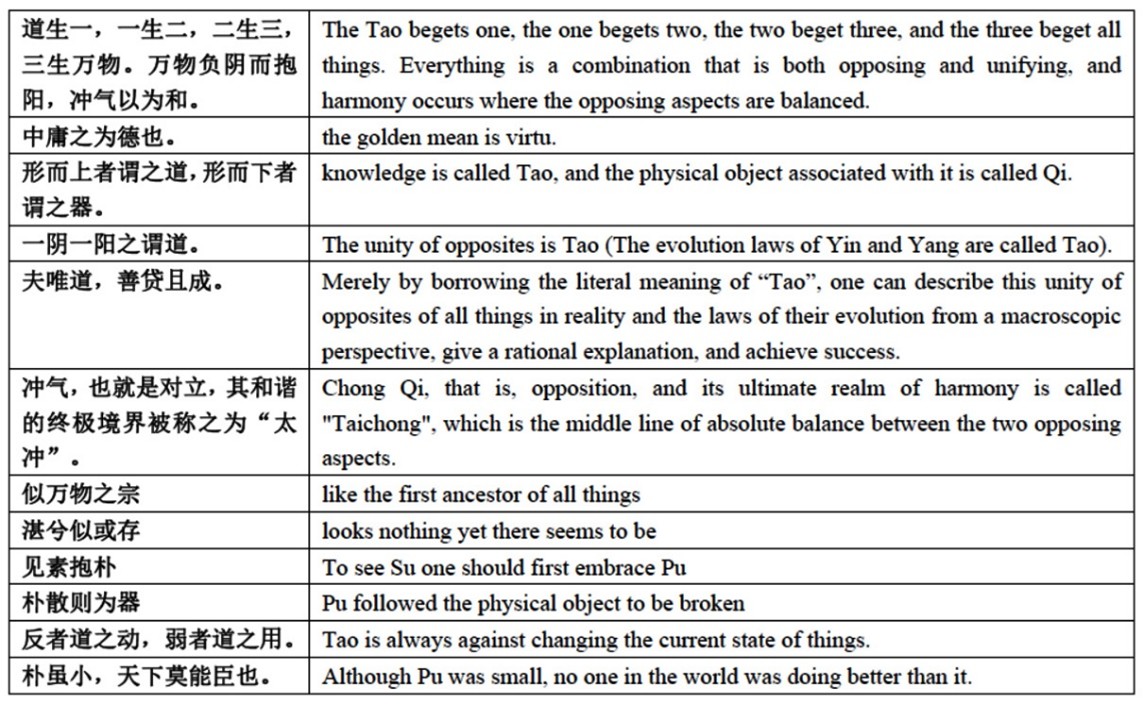
Reason, namely knowledge, is also the "Tao" defined by the statement "knowledge is called Tao, and the physical object associated with it is called Qi" in the Xi Ci I of Zhou Yi (The Book of Changes). However, "Tao" in the Tao Te Ching differs from this. It is equivalent to the "Tao" defined by "the unity of opposites is Tao" (the evolution laws of Yin and Yang are called Tao) in the aforementioned Xi Ci I. That is, it encompasses not only all knowledge but also all physical objects. To this, in Chapter 41 of the Tao Te Ching, it is said: "Merely by borrowing the literal meaning of 'Tao', one can describe this unity of opposites of all things in reality and the laws of their evolution from a macroscopic perspective, give a rational explanation, and achieve success."
So, in Chapter 42 of the Tao Te Ching, it is said: "The Tao begets one, the one begets two, the two beget three, and the three beget all things. Everything is a combination that is both opposing and unifying, and harmony occurs where the opposing aspects are balanced." It is the trichotomy that is used to explain this "Tao", which is both opposing and unifying. Among them, the meanings of "one" and "two" are clear, that is, the unity and its two opposing aspects, which can be represented by the Tai Chi diagram of Yin and Yang embracing each other. "Yin" and "Yang" refer to two opposing aspects in general, while "harmony" means unity, but it must be achieved through "Chong Qi".
Chong Qi, that is, opposition, and its ultimate realm of harmony is called "Taichong", which is the middle line of absolute balance between the two opposing aspects. Obviously, Taichong is a unanimous consensus, has absoluteness, and means rules and unity, but the emphasis lies in understanding its immutability, that is, everything is changing, while Taichong remains unchanged. In other words, Taichong is also a truth defined by Kant's criterion. This is the "three" in "the two beget three", just like every absolute point position on the number axis, which does not exist in reality and belongs to the category of metaphysics. As the "background", it not only forms qualitative opposites with the two opposing aspects, but also can clearly distinguish between the two, so this "three" that is Taichong, namely the third aspect, is indispensable. And the "three" in "the three beget all things" refers to the fact that every unity of opposites in reality must have three kinds of origins, that is, the two opposing aspects and Taichong.
It is a pity that the Tao Te Ching contains no judgment like that found in Western philosophy on whether Taichong (this "Three") exists in reality, and only describes from a macro perspective the characteristics of the "Tao" that is a unity of opposites. In Chapter 4 of the Tao Te Ching, from such phrases as "like the first ancestor of all things" and "looks like nothing yet there seems to be", it can be seen that although one can clearly see what it looks like, one cannot be sure of what it truly is, that is, within the knowledge framework of Dualism, the "Tao" is in a state of chaos, appearing and disappearing.
To see Su one should first embrace Pu
It can be seen that this "three" (the third aspect) put forward by Mr. Pang Pu should form qualitative opposites with the two opposing aspects, which is really a step further in promoting the unity of Eastern and Western philosophy. However, although he sought solutions in many ways, extensively verifying and precisely explaining, he ultimately failed to achieve his wish due to the neglect of the deep study of inertia. Moving from vagueness to clarity and from ambiguity to consensus is the only way to advance from Dualism towards Trialism, and the key lies in the in-depth study and understanding of inertia.
My own view is that the phrase "Pu followed the physical object to be broken" in Chapter 28 of the Tao Te Ching can be interpreted through Chairman Mao's "From a philosophical point of view, matter is infinitely divisible". The principle of seeking limits in mathematics is precisely their abstraction. Among them, this "Pu" corresponds to inertia, which is the source of the nature of everything in reality, while the infinitely divisible corresponds to the arbitrarily small. This means that even if an object is broken up into arbitrarily small particles, they still have inertia, that is, the physical object and inertia are inseparable. Therefore, it can be seen that the "Su" in "To see Su one should first cherish Pu" in Chapter 19 of the Tao Te Ching corresponds to the essence of things.
Given that everything is formed by arbitrarily small particles through the process of "two combining into one", the concept of "one should first cherish Pu" therein means that in order to see the essence of things, the key lies in grasping inertia first, and only then can it drive other links. And the phrase "Tao is always against changing the current state of things" in Chapter 40 of the Tao Te Ching is precisely the characteristic that inertia presents. In other words, near Taichong, inertia is in the state of "keeping balance", and is equivalent to the "middle" of the Doctrine of the Mean, which is also the essence and statecraft of Confucianism.
Thus, in physics, the measure of the magnitude of an object's inertia is defined as mass, which is equal to density multiplied by volume, and density is the amount of matter contained per unit volume. Matter has inertia, and inertia leads to continuity, and continuity generates knowledge through reasoning, which is precisely an inevitable result. We may also ponder the following questions based on the aforementioned concepts of the infinitely divisible and the arbitrarily small: What is "being"? What is "non-being"? What is "being and non-being beget each other"? And how can we achieve "To see Su one should first cherish Pu"?
So, whether they are the arbitrarily small particles formed by the process of "one divided into two" or all things in reality formed by the process of "two combining into one", they are all unities of opposites formed through inertia. This means that not only all knowledge, but also wisdom, emotions, desires and so on, should reside together with inertia and generate continuity through inertia with relevant physical objects. In other words, the saying "Although Pu was small, no one in the world was doing better than it" in Chapter 32 of the Tao Te Ching can be interpreted as follows: Although inertia is arbitrarily small, it can govern all things in reality. The above lists discussions on certain terms related to inertia in the Tao Te Ching. Although these discussions may seem inconsistent with their original context at first glance, I hope that wise people can judge rationally according to the Trialism on things' limits and will be bound to gain insights.
Furthermore, the above-mentioned philosophical view that "matter is infinitely divisible" is correct. It was put forward on the afternoon of January 15, 1955, when Chairman Mao was listening to reports from scientists such as Li Siguang and Qian Sanqiang. This is because, in reality, absolute rest (or constancy) does not exist. As a result, everything can only be in the process of change. This is the truth. The philosophical views of "one divided into two" by Chairman Mao and "two combining into one" by Mr. Yang Xianzhen also originated from this concept of "change".
As discussed in this article, inertia generates continuity, which can break through the bondage of finite thinking and go from the quantitative change of real space all the way deep into the qualitative change of the ideal realm. And it carries on the past and opens up the future, cautiously pioneers the unfinished business of our predecessors, eliminates the false and retains the true, in order to lay the foundation for the unity of Eastern and Western philosophies. May philosophy be brought back to rebirth in honor of the sages of the past.
To the Readers
The core arguments of this paper are twofold: first, truth must be without ambiguity; second, inertia is ubiquitous in reality and also serves as the residing place of truth. Starting from the premise that truth must be without ambiguity, it can be deduced that truth does not exist in reality and belongs to the realm of metaphysics. Then, turning back, truth can generate continuity with the relevant objective things in reality through the inertia that resides together with it. Thus, one can conduct a reasoning process from philosophy to science based on objective facts, and the conclusion must be correct as long as there is no problem with the process of reasoning. The reverse is also true.
It should be noted that on the basis of Dualism, Trialism adds the non-existent "background", namely truth, in accordance with the principle that this newly introduced third aspect must form a qualitative opposition with the two opposing aspects in reality. As a "background", there is neither continuity among various truths nor a chronological order between them. However, they can rely on the inertia of relevant objective things in reality to generate continuity and form logical causal relationships, but no contradictory situations can arise. And in reality, there is inevitably a time lag between cause and effect, whose underlying mechanism lies in inertia. In physics, the measure of the magnitude of an object's inertia is defined as mass. Therefore, the mass of any object in reality, including photons, must be greater than zero.
As for readers, they may raise the following questions after reading this article.
- How Trialism differs from Dualism and traditional forms of trichotomy;
- Whether inertia is intended as a physical principle, a metaphysical principle, or both;
- How continuity functions within the author's epistemological framework;
- Why truth is said to "reside" in inertia.
Obviously, all four questions reflect thinking within the theoretical framework of Dualism. The answers can be found in this paper. As for shortcomings such as unclear explanations and the repetition of certain core points, I would be deeply grateful for the readers' corrections.
The key to Trialism lies in the recognition that truth does not exist in reality, for it must be without ambiguity. The so-called "relative truth" is itself an objective existence in reality (with ambiguity), so it cannot form a qualitative opposition to the two opposing aspects within reality. In essence, it is still thinking within the dualistic knowledge framework. This is precisely where the answer to "how Trialism differs from Dualism and traditional forms of trichotomy" lies.
I firmly believe that Dualism will inevitably and rationally return to Trialism. This is a great undertaking beneficial to human progress, and there are many, many things to be done. Within the dualistic knowledge framework, besides Kant's criterion mentioned above, Newton's First Law serves as the most typical example that embodies Trialism. As the introduction of the concept of absolute motion, Newton's First Law of motion can be called the starting point of classical physics, which has been widely applied to the physical space in reality, and is the best example.
The law is also known as the law of inertia. The body described therein is unaffected by forces. Whether it is stationary or moving in uniform motion along a straight line, its motion state is absolute (or ideal). It does not exist in reality and ought to be classified as metaphysics. Therefore, the law is a truth and can be applied to all disciplines. Especially in the field of physics, the coordinate system established according to this has described the absolute space-time of Newtonian mechanics. Only with this as the criterion can we start from an absolutely error-free consensus to explore the changes of objective things in reality through reasoning.
Within the knowledge framework of Dualism, truth has no place to reside, and this law is usually classified into the domain of physics (science). The current mainstream cognition is formed under the framework of Dualism, so truth has no place to reside. But does this law ultimately belong to science or to philosophy (metaphysics)? Under the premise of not realizing that truth does not exist in reality but there is continuity between it and the relevant objective things, the term "philosophy of science" emerged accordingly.
Finally, this essay concludes by invoking the lifelong goal pursued by Sir Isaac Newton: theological (metaphysical) thought and scientific ideal were closely related, which was an organic whole, and the wisdom in one domain might enlighten the wisdom in another.
Key Insights from the Article
There is continuity between truth and relevant objective things in reality, with inertia serving as its intrinsic mechanism.
Trialism improves upon dualism by recognizing a necessary third aspect—the unambiguous consensus belonging to metaphysics.
Truth does not exist physically in reality, possesses absoluteness and immutability, and acts as a limit value similar to mathematical limits.
Inertia acts as a necessary condition for continuity, which in turn is a requirement for valid logical reasoning and causality.
Metaphysics functions as the absolute background and first philosophy, providing the non-existent foundation required for scientific measurements and definitions.
Philosophy is defined as human knowledge structured through reasoning based on objective things while exploring natural laws and approaching truth.
Materialism demands rigorous reasoning without breaking continuity, whereas idealism frequently introduces arbitrary ideas that disrupt continuous logic.
The Trialism on things' limits unifies diverse philosophical frameworks, including Eastern concepts like the Tao Te Ching and Western dialectical materialism.
Newton's First Law of motion exemplifies a metaphysical truth acting as an absolute baseline reference for physical sciences.
Unifying dualism back into trialism bridges the gap between science and metaphysics, fostering a comprehensive understanding of natural laws.
Conflict of interest statement
None declared.
References
- Ding, J. The Social System Defined by Trialism. Journal of NeuroPhilosophy, 2026; 5(1):109-118. DOI: 10.5281/zenodo.20051564
- Mao Z D. Selected Works of Mao Zedong (Vol. 1). Beijing: People's Publishing House, 1991: 299-340. (in Chinese)
- Wang B and Lou Y L. The Collation and Explanation of Tao Te Ching by Lao Tzu. Beijing: Zhonghua Book Company, 2008. (in Chinese)
- Suo Q Y. (2024). Confucius' Doctrine of the Mean and Its Modern Value. Advances in Philosophy, 13(6): 1147-1153. (in Chinese)
- Pang P. SANSHENG WANWU (The Three Beget All Things). Beijing: Capital Normal University Press, 2011. (in Chinese)
- Jian Ding. The Theory on Thing’s Limits. Part 4: The Definition of Philosophy. J Mat Sci Eng Technol. 2025. 3(3): 1-6. DOI: 10.61440/JMSET.2025.v3.56
- Sakyamuni. Dirghagama-sutra (Vol. 19). Buddhayasas, Zhu Fonian. Beijing: Sino-Culture Press, 2013: 609-610. (in Chinese)
- Kant, Immanuel. Critique of Pure Reason. Translated by Paul Guyer and Allen W. Wood, Cambridge University Press, 1998, A58/B82.
- Jian DING. The Theory on Thing’s Limits. Part 3: The Root Cause of Modern Physics’ Century-Long Wandering. Open Access Journal of Physics 2024;6(1):22-30. DOI: 10.22259/2637-5826.0601004
- Ding, J. The Theory on Thing’s Limits. Part 2: A Brief Analysis of the New Knowledge of Newton’s First Law. Journal of Electronic & Information Systems 2023; 5(1): 10-19. DOI: 10.30564/jeis.v5i1.5548
- Principle of inertia - Baidu Encyclopedia. (in Chinese) https://baike.baidu.com/item/%E6%83%AF%E6%80%A7%E5%8E%9F%E5%88%99/2653012
- Guo Yu (Annotator & Translator). Zhou Yi (The Book of Changes). Beijing: Zhonghua Book Company, 2012: 360, 375. (in Chinese)
- Zhao K. Mao Zedong's Reading and Study Career (Part 2). Study Times, 2021-08-02, A5. (in Chinese)
- Wen H W. Study on the Newtonian religious ideas [D]. Jinhua in China: Zhejiang Normal University, 2009: 16. DOI: 10.7666/d.y1549479 (in Chinese)
Authors hold copyright with no restrictions. This work is licensed under CC BY.