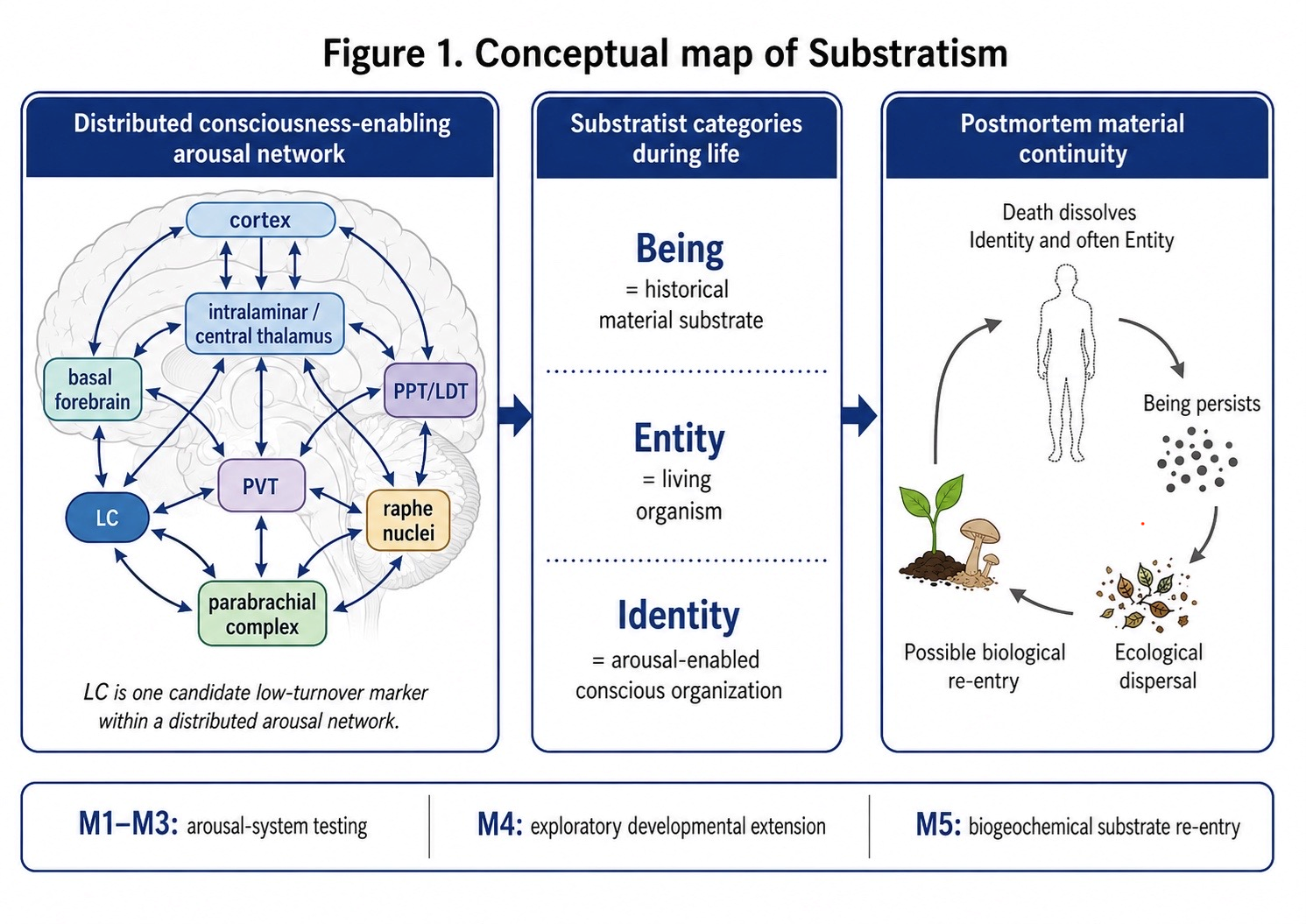
Substratism is a neurophilosophical framework in personal identity and consciousness studies. It addresses a category error common to discussions of consciousness and death: the conflation of the cessation of conscious organization with the termination of material existence. The framework maintains three strictly distinct categories. Being is the historically continuous material substrate that participated in the consciousness-enabling biological organization of the person. Entity is the autopoietic living organism. Identity is the arousal-enabled conscious organization instantiated upon that substrate during life. Death dissolves Identity and typically Entity, but does not annihilate Being. In this framework, postmortem material continuity refers only to the lawful persistence, dispersal, and possible biological re-entry of the historical material substrate that constituted a person. It does not refer to memory survival, soul survival, personality continuation, resurrection, reincarnation, religious afterlife, near-death experience, paranormal survival, or uninterrupted continuation of the current first-person stream of experience. Biogeochemical substrate re-entry names the possible later incorporation of such material into living systems. These are material-continuity terms, not religious or psychological-survival claims. Brainstem-thalamic arousal systems are treated as necessary enabling conditions for wakeful conscious presence, not as sufficient generators of full human identity. The locus coeruleus is a candidate low-turnover marker within a distributed ascending arousal system, not the seat of selfhood or consciousness. If a different consciousness-enabling tissue better satisfies the retention and functional criteria, the candidate substrate must be relocated and the locus-coeruleus-specific version of the hypothesis is treated as falsified. The article proposes a staged research program of experimental protocols, to be preregistered before any future data collection, designed to test atom retention in candidate macromolecules, arousal-system dependence in disorders of consciousness, and biogeochemical substrate re-entry of historical material substrate. No new data are reported. The contribution is to make material-token continuity philosophically explicit, distinguish it from psychological, narrative, organismal, and pattern-copy accounts of personal identity, and specify the empirical conditions under which substrate continuity within consciousness-enabling biology can be tested or constrained.
Introduction
Personal-identity theory has long oscillated between psychological-continuity accounts grounded in memory and narrative (Locke, 1689/1975; Parfit, 1984; Schechtman, 1996) and animalist accounts that ground persistence in organismal life (Olson, 1997). In parallel, consciousness studies has distinguished conscious level or state from conscious content and has converged on the importance of brainstem-thalamic arousal architecture for sustained wakeful access (Dehaene and Changeux, 2011; Koch et al., 2016; Aston-Jones and Cohen, 2005; Schiff et al., 2007; Edlow et al., 2012; Edlow et al., 2024). Molecular turnover biology has separately shown that some neuronal populations are developmentally long-lived (Spalding et al., 2005), that nuclear-pore scaffolds and other long-lived proteins exhibit exceptional stability rather than ordinary rapid turnover (Toyama et al., 2013), and that locus coeruleus neurons contain neuromelanin-related material markers relevant to low-turnover substrate analysis without functioning as simple lifelong population-level archives (Zucca et al., 2017; Riley et al., 2025). These literatures are rarely integrated.
The integrative gap is the absence of a framework that takes seriously what would follow if the historical material substrate of consciousness-enabling biology were treated as identity-relevant in a sense distinct from memory, narrative, organismal life, or pattern-copy identity. Substratism articulates that framework. It maintains three strictly distinct categories — Being (the historically continuous material substrate that participated in the consciousness-enabling biological organization of the person), Entity (the autopoietic living organism), and Identity (the arousal-enabled conscious organization instantiated upon that substrate during life) — and argues that the deepest same-one continuity of an individual, where any such continuity obtains, is grounded in material-token continuity within consciousness-enabling biology. The article uses postmortem material continuity as a bounded technical term denoting only the lawful persistence, dispersal, and possible biological re-entry of that historical substrate. It does not denote soul-survival, memory-survival, personality continuation, resurrection, reincarnation, religious afterlife, or uninterrupted continuation of the current first-person stream of experience. Death dissolves Identity and often Entity, but not Being.
The article's contribution is to join personal-identity philosophy, consciousness-enabling neurobiology, and molecular turnover biology. It specifies a five-level claim hierarchy that separates empirical claims from philosophical commitments. It also identifies the locus coeruleus as one candidate substrate for empirical scrutiny while foregrounding that the relevant arousal architecture is distributed rather than LC-exclusive. The Materials and Methods section sets out the methodological posture, the claim hierarchy, and a staged research program. The Results and Discussion section develops the framework, situates it relative to existing theories, presents candidate substrates, sets the philosophy-of-science boundary, addresses six core objections, and identifies the conditions under which the framework would be weakened.
Materials and Methods
Methodological Approach
This article combines conceptual analysis, inference to the best explanation, and empirical constraint mapping. Conceptual analysis distinguishes Being, Entity, and Identity. Inference to the best explanation compares Substratism against psychological, organismal, informational, and biological accounts of continuity. Empirical constraint mapping identifies where neuroscience, molecular turnover biology, and isotope tracing can test or limit the framework. The aim is not to establish personal survival experimentally, but to identify whether a material-continuity condition has been underexamined in theories of personal identity and consciousness.
Claim Hierarchy
The framework's claims are graded across five levels, kept separate so that evidence supporting any lower level cannot be treated as automatic confirmation of a higher level.
Level 1 — Conservation premise. The atoms that composed a person persist after death and disperse through ordinary biogeochemical cycling.
Level 2 — Biological-substrate premise. Certain postmitotic neurons and macromolecular assemblies exhibit extremely low molecular turnover; some components can be as old as the individual, while neuromelanin-related LC markers must be treated cautiously because LC signal and neuronal integrity can vary across aging and neurodegeneration (Spalding et al., 2005; Toyama et al., 2013; Zucca et al., 2017; Riley et al., 2025).
Level 3 — Operational claim. The historical personal substrate can in principle be traced using retrospective isotope-tracing logic, accelerator mass spectrometry, nanoSIMS, and mass-balance methods, subject to specified detection thresholds and controls. With current technology, these methods are best treated as postmortem or ex vivo approaches rather than in vivo atom-tracking methods in living human consciousness-enabling neurons.
Level 4 — Neurobiological hypothesis (the locus-coeruleus-specific Being-Core Hypothesis, BCH). A low-turnover, continuity-bearing candidate substrate may exist within consciousness-enabling brainstem-thalamic arousal systems. The locus coeruleus is treated as a candidate marker within a distributed ascending reticular activating system (ARAS), not as the sole anatomical seat of arousal, selfhood, or consciousness (Edlow et al., 2012; Aston-Jones and Cohen, 2005). This level is falsifiable.
Level 5 — Philosophical identity thesis. If such a substrate is continuity-bearing, then same-one continuity is deeper than memory continuity, narrative continuity, organismal life, or abstract pattern-copy identity. This is a philosophical thesis informed by, but not reducible to, evidence at Levels 1–4. A failure at Level 4 falsifies the LC-specific BCH but leaves the broader framework available only by relocation to a tissue that better satisfies the same retention and functional criteria under the same standards.
Epistemic bridge principle: Evidence at Levels 1-4 constrains Level 5 only when the same candidate substrate satisfies three conditions: material retention, consciousness-enabling functional relevance, and operational traceability. If a candidate arousal-system substrate showed unusually high material retention and reliable dependence relations with validated measures of conscious state or complexity, then the Level-5 thesis would become a more plausible interpretation of continuity. It would not be logically forced. Conversely, if no consciousness-enabling substrate satisfies retention, functional relevance, and traceability together, the Level-5 interpretation loses empirical traction even if ordinary material conservation remains true.
Proposed Research Program
The proposed research program is staged rather than presented as a completed experiment. M1 examines disorders-of-consciousness cases to test whether arousal-system integrity corresponds to behavioral responsiveness and brain-complexity measures, drawing on PCI/PCI-ST and CRS-R logic (Casarotto et al., 2016; Comolatti et al., 2019; Schiff et al., 2007; Edlow et al., 2012). M2 compares the locus coeruleus with alternative arousal nodes such as the paraventricular thalamus and basal forebrain (Ren et al., 2018; Aston-Jones and Cohen, 2005). M3 tests projection-specific arousal pathways, especially LC–thalamic interactions. M4 is retained only as an exploratory developmental-timing extension. M5 uses isotope-tracing logic to model postmortem material continuity and possible biogeochemical re-entry (Spalding et al., 2005; Toyama et al., 2013). Across all protocols, thresholds, stimulation parameters, imaging proxies, and statistical models are working specifications to be finalized before future data collection. Positive results would support or constrain Levels 1–4; they would not prove psychological survival or settle the Level-5 philosophical thesis. The bridge between arousal-system testing and atom-retention testing requires convergence rather than simple association. Arousal-system integrity alone would not establish material-token continuity, and isotope tracing alone would not establish consciousness-enabling relevance. A candidate substrate becomes relevant to Substratism only if it shows low turnover or historical material retention, functional implication in arousal-enabled conscious organization, and traceability by postmortem or ex vivo methods. M1-M3 therefore test functional relevance, whereas M5 tests material continuity. The framework gains empirical force only where these lines of evidence converge on the same candidate substrate or substrate class. The conceptual map summarizing the framework and the proposed protocols is shown in Figure 1.
Results and Discussion
No new experimental data are reported. The material that follows presents theoretical predictions, expected outcomes, and proposed falsification criteria. The philosophical thesis (Level 5) is held distinct from the evidence-bearing claims (Levels 1–4).
Being, Entity, and Identity
Substratism argues that the deepest continuity of the same individual, where any such continuity obtains, is grounded not primarily in memory, narrative, personality, organismal life, or abstract informational pattern, but in a historically continuous material substrate that once participated in the consciousness-enabling biological organization of that individual. The framework rests on three strictly distinct categories: Being, Entity, and Identity. It asserts no immaterial residue, no surviving subjectivity, no preserved memory, and no continued personhood after death. The central categories are summarized in Table 1.
| Category | Definition | What ends at death? | What persists? | Candidate testable marker |
|---|---|---|---|---|
| Being | Historically continuous material substrate that participated in the consciousness-enabling biological organization of the person | Does not end; matter is conserved | Material substrate persists and disperses through biogeochemical cycling | Atom-retention assays; isotopic mass-balance closure |
| Entity | Autopoietic living organism; self-maintaining biological unity holding the substrate together during life | Typically ends at biological death; organismal integration collapses | No organismal unity; tissues dissociate | Clinical/functional markers of organismal viability; criteria for biological death |
| Identity | Arousal-enabled conscious organization instantiated upon the substrate during life | Ends at the loss of the arousal-enabled organization | No psychological continuity; no memory, narrative, or perspectival continuation | PCI/PCI-ST; behavioural responsiveness (CRS-R); composite arousal-system indices |
Two states of affairs that share the same Being need not, and typically do not, share the same Identity. If a portion of a person's material substrate is incorporated into a new organized living system, a new Identity may arise on that substrate, numerically distinct from the prior Identity, sharing no memory, narrative, perspective, or subjective continuity with it. Substratism claims that Being persists; it does not claim that Identity persists, returns, or recurs. Substratism does not claim that the previous subject, memory, or the old perspective continues; it claims that the historical material substrate may become experience-bearing again only if reorganized with a new consciousness‑enabling biological system.
Death, Oblivion, and Postmortem Material Continuity
Strong versions of the "eternal oblivion" thesis hold that death is the total annihilation of the person. Substratism rejects only one part of this thesis: the part that treats loss of consciousness as loss of material Being. The framework agrees that death dissolves Identity and typically dissolves Entity, but denies that it annihilates Being. This denial is not a claim of survival in any psychological, religious, or supernatural sense. It does not assert that memory, personality, soul, ego, resurrection, reincarnation, or uninterrupted conscious experience persist across the moment of biological death. It asserts that the matter that participated in the person's conscious life persists lawfully and may, through ordinary biogeochemical processes, re-enter biological systems elsewhere. The framework's central statement: Death dissolves Identity and often Entity, but not Being; Being persists as conserved historical material substrate and may lawfully re-enter life through ecological cycling.
What This Theory Does Not Claim
The framework does not claim that memory, personality, autobiographical narrative, or consciousness survives death. It does not claim the existence or persistence of a soul. It does not claim that reincarnation, resurrection, or any religious survival doctrine is empirically supported. It does not claim that isotope tracing supports personal psychological survival. It does not claim that the locus coeruleus is the seat of selfhood or consciousness. It does not claim to explain why arousal-enabled organization is accompanied by phenomenal experience. It asks whether a continuity-bearing material substrate within consciousness-enabling biology could ground a stricter notion of same-one continuity than psychological, organismal, or informational accounts can supply, and proposes how that question can be empirically constrained.
Theoretical Positioning
Substratism is in tension with the major personal-identity programmes. Locke (1689/1975) and the broad psychological-continuity tradition that Parfit (1984) and Schechtman (1996) extended ground the same person in psychological connections among mental states; Substratism does not endorse those psychological connections as the deepest layer of same-one continuity. Animalism (Olson, 1997) grounds persistence in organismal life; on Substratism, organismal life is the Entity layer, distinct from the substrate-token continuity of Being and from arousal-enabled Identity. The framework is incompatible with strict pattern-copy criteria of identity: a perfect functional copy with no shared historical substrate would, on Substratism, instantiate a different Being even if the resulting Identity were qualitatively indistinguishable. This point also clarifies the framework's relation to Parfit's "what matters" analysis. Substratism does not deny that psychological continuity, memory, character, and experiential connectedness matter at the level of Identity. It denies only that those relations exhaust all forms of continuity.
Candidate Neurobiological Substrates
The locus coeruleus is a candidate target because of its noradrenergic projections, arousal relevance, postmitotic neuronal status, and neuromelanin-related material stability in surviving catecholaminergic neurons (Aston-Jones and Cohen, 2005; Zucca et al., 2017; Riley et al., 2025). However, the framework does not privilege the LC as the seat of selfhood, consciousness, or personal identity. The ascending arousal system is distributed and includes the paraventricular thalamus, basal forebrain cholinergic systems, raphe nuclei, parabrachial complex, pedunculopontine and laterodorsal tegmental nuclei, intralaminar or central thalamic nuclei, and related brainstem-thalamic-cortical pathways (Edlow et al., 2012; Ren et al., 2018; Edlow et al., 2024). LC is therefore best treated as one candidate low-turnover marker within a broader consciousness-enabling arousal network. If another node or tissue class better satisfies material retention, functional relevance, and traceability, the candidate substrate must shift.
Philosophy-of-Science and Epistemic Boundary
The empirical tests proposed here examine material continuity, not psychological survival. Substrate continuity at the cellular, scaffold, or molecular level is testable in principle through isotope-tracing logic and validated complexity-and-arousal proxies; the philosophical claim that such continuity grounds the deepest sense of same one — the Level-5 thesis — is constrained but not entailed by any positive empirical finding at Levels 1–4. The framework treats carbon and nitrogen as practical tracing targets because of biological abundance and assay accessibility, not because they are uniquely identity-bearing (No Privileged Carbon). The framework is empirically constrained and philosophically committed. Empirical refutation at Levels 1-4 would weaken Level 5; empirical confirmation at Levels 1-4 would not settle Level 5, which remains a metaphysical thesis. The constraint is evidential, not deductive.
Objections and Boundary Conditions
Six objections are anticipated. The One-Atom Problem: identity cannot turn on a single atom; the framework concedes this and treats Being as a population-level historical-substrate property admitting of degree. The Dilution Problem: matter disperses to many recipients after death; the framework concedes biogeochemical dispersal and treats biological re-entry as numerical, not personal, identity-bearing — same Being is not same Identity. The Copy / Teleporter Problem: a perfect functional copy with no shared historical substrate would, on Substratism, instantiate a different Being even if the copy's Identity were qualitatively indistinguishable. The LC-overcommitment objection: the locus coeruleus is not the seat of selfhood or consciousness; it is named only as one candidate substrate within a distributed arousal-enabling network, and the framework relocates if alternative arousal nodes better satisfy material retention, functional relevance, and traceability. The REM / LC-OFF objection weakens any LC-exclusive account of consciousness. Substratism therefore does not treat LC activity as a necessary moment-by-moment generator of experience. The Arousal vs. Consciousness objection: arousal is not the whole of consciousness; the framework explicitly treats arousal as an enabling condition, not a sufficient one for conscious content, reportable access, or full personal identity (Dehaene and Changeux, 2011; Koch et al., 2016).
Limitations and What Would Weaken the Theory
Several findings would weaken the framework. (i) If precise functional duplicates with no shared historical substrate proved to instantiate the same person under every defensible criterion of personal identity, the substrate-token premise of Being would fail. (ii) If atom-retention data showed that wakefulness-related neuronal substrates undergo total atomic turnover on a timescale shorter than diachronic Identity, the candidate-substrate thesis at Level 2 would fail. (iii) If complexity-and-arousal measures dissociated entirely from any candidate substrate across disorders of consciousness, the Level-3 functional linkage would fail. (iv) If projection-specific manipulation of LC-thalamic pathways had no effect on arousal-driven complexity measures, the LC-specific corollary would be falsified, though the framework would relocate only if another candidate substrate satisfied material retention, functional relevance, and traceability together. The framework is limited by the current unavailability of direct human in vivo atom-retention data, by the early state of validated complexity proxies in non-research clinical settings, and by the fact that Level 5 is a philosophical thesis not settled by any finite empirical evidence; it does not explain why arousal-enabled organization is accompanied by phenomenal experience, does not entail psychological survival, and does not specify a translational protocol.
Abbreviations
AMS, accelerator mass spectrometry; ARAS, ascending reticular activating system; BCH, Being-Core Hypothesis; CRS-R, Coma Recovery Scale–Revised; LC, locus coeruleus; PCI-ST, perturbational complexity index-state transition; REM, rapid eye movement.
- 1. Substratism distinguishes Being (historical material substrate), Entity (living organism), and Identity (arousal-enabled conscious organization) as three separate categories.
- 2. Death dissolves Identity and typically Entity, but Being persists as conserved material substrate that may re-enter biological systems.
- 3. The framework does not claim memory, personality, or consciousness survives death; it rejects conflating loss of consciousness with annihilation of material Being.
- 4. A perfect functional copy without shared historical substrate instantiates a different Being, even if its Identity is qualitatively indistinguishable.
- 5. The locus coeruleus is a candidate low-turnover marker within a distributed arousal network, not the seat of selfhood or consciousness.
- 6. Empirical testing of substrate continuity requires convergence of material retention, consciousness-enabling functional relevance, and traceability.
- 7. Atom-retention in postmitotic neurons and long-lived macromolecules provides a possible empirical anchor for material-continuity claims.
- 8. The Level-5 philosophical identity thesis (material continuity as deepest same-one continuity) is constrained but not entailed by Levels 1–4 evidence.
- 9. Substratism is compatible with global neuronal workspace theories but does not attempt to explain why arousal-enabled organization yields phenomenal experience.
- 10. If precise functional duplicates with no shared historical substrate were considered the same person, the substrate-token premise of Being would be falsified.
References
- Aston-Jones G, Cohen JD. An integrative theory of locus coeruleus-norepinephrine function: adaptive gain and optimal performance. Annual Review of Neuroscience 2005; 28: 403-450.
- Casarotto S, Comanducci A, Rosanova M, Sarasso S, Fecchio M, Napolitani M, et al. Stratification of unresponsive patients by an independently validated index of brain complexity. Annals of Neurology 2016; 80(5): 718-729.
- Comolatti R, Pigorini A, Casarotto S, Fecchio M, Faria G, Sarasso S, et al. A fast and general method to empirically estimate the complexity of brain responses to transcranial and intracranial stimulations. Brain Stimulation 2019; 12(5): 1280-1289.
- Dehaene S, Changeux J-P. Experimental and theoretical approaches to conscious processing. Neuron 2011; 70(2): 200-227.
- Edlow BL, Takahashi E, Wu O, Benner T, Dai G, Bu L, et al. Neuroanatomic connectivity of the human ascending arousal system critical to consciousness and its disorders. Journal of Neuropathology and Experimental Neurology 2012; 71(6): 531-546.
- Edlow BL, Olchanyi M, Freeman HJ, Li J, Maffei C, Snider SB, et al. Multimodal MRI reveals brainstem connections that sustain wakefulness in human consciousness. Science Translational Medicine 2024; 16(745): eadj4303.
- Koch C, Massimini M, Boly M, Tononi G. Neural correlates of consciousness: progress and problems. Nature Reviews Neuroscience 2016; 17(5): 307-321.
- Locke J. An Essay Concerning Human Understanding (Nidditch PH, ed.). Oxford: Clarendon Press, 1975. (Original work published 1689.)
- Meier LJ. Memories without survival: personal identity and the ascending reticular activating system. Journal of Medicine and Philosophy 2023; 48(5): 478-491.
- Olson ET. The Human Animal: Personal Identity Without Psychological Continuity. New York: Oxford University Press, 1997.
- Parfit D. Reasons and Persons. Oxford: Oxford University Press, 1984.
- Ren S, Wang Y, Yue F, Cheng X, Dang R, Qiao Q, et al. The paraventricular thalamus is a critical thalamic area for wakefulness. Science 2018; 362(6413): 429-434.
- Riley E, Cicero NG, Mabry SA, Swallow KM, Anderson AK, De Rosa E. Age-related differences in locus coeruleus intensity across a demographically diverse sample. Neurobiology of Aging 2025; 150: 122-131.
- Schechtman M. The Constitution of Selves. Ithaca, NY: Cornell University Press, 1996.
- Schiff ND, Giacino JT, Kalmar K, Victor JD, Baker K, Gerber M, et al. Behavioural improvements with thalamic stimulation after severe traumatic brain injury. Nature 2007; 448(7153): 600-603.
- Spalding KL, Bhardwaj RD, Buchholz BA, Druid H, Frisén J. Retrospective birth dating of cells in humans. Cell 2005; 122(1): 133-143.
- Toyama BH, Savas JN, Park SK, Harris MS, Ingolia NT, Yates JR, et al. Identification of long-lived proteins reveals exceptional stability of essential cellular structures. Cell 2013; 154(5): 971-982.
- Zucca FA, Segura-Aguilar J, Ferrari E, Muñoz P, Paris I, Sulzer D, et al. Interactions of iron, dopamine and neuromelanin pathways in brain aging and Parkinson's disease. Progress in Neurobiology 2017; 155: 96-119.