The question of whether quantum mechanical phenomena play a functional role in brain activity and the emergence of consciousness remains one of the most controversial yet intellectually stimulating debates at the intersection of physics, neuroscience, and philosophy of mind. This review systematically examines the principal theoretical frameworks proposing quantum-level mechanisms in neural computation, including the Orchestrated Objective Reduction (Orch OR) hypothesis by Penrose and Hameroff, the quantum brain hypothesis of Stapp, quantum coherence models in microtubules, and quantum field theories of consciousness. We critically evaluate the current state of empirical evidence—including recent quantum biology findings, the challenge of decoherence in warm biological systems, and experimental observations of quantum effects in biological systems—alongside computational models that bridge quantum formalism and neural network dynamics. Furthermore, we discuss the implications of quantum cognition models for understanding perception, decision-making, and memory. Despite significant scientific skepticism, emerging evidence from quantum biology and advanced neuroimaging technologies provides tentative support for quantum processes in neural substrates. We conclude by identifying critical gaps in current knowledge and outlining future research directions that may resolve the debate, including proposals for experimental paradigms using quantum sensing technologies applied to neural tissue. This review aims to serve as a foundational reference for researchers across disciplines approaching the quantum mind hypothesis with scientific rigor.
1. INTRODUCTION
Consciousness—the subjective, first-person experience of awareness—remains one of the deepest unsolved problems in science. How does the physical activity of billions of neurons give rise to the rich, unified experience of being? Classical neuroscience, rooted in electrochemical signaling and network dynamics, has made enormous strides in mapping neural correlates of cognition, yet it has not provided a complete mechanistic explanation for phenomenal consciousness (Chalmers, 1995). This explanatory gap—what Chalmers famously termed the 'hard problem of consciousness'—has motivated researchers to look beyond classical physics for explanatory frameworks.
Quantum mechanics, the most precisely verified theory in the history of physics, governs the behavior of matter and energy at the subatomic scale. Its hallmark features—superposition, entanglement, tunneling, and non-locality—operate by fundamentally different rules from the deterministic, classical mechanics that underpins most biological models. The proposal that these quantum phenomena might be directly relevant to brain function and the emergence of mind has been alternately celebrated as a revolutionary insight and dismissed as unfounded speculation (Tegmark, 2000).
The intellectual lineage of the quantum mind hypothesis can be traced to John von Neumann's (1932) formulation of quantum measurement theory, which placed a special role on the observer's consciousness in wave function collapse. This idea was later developed by Wigner (1961), who proposed that consciousness might be physically distinct from matter. Roger Penrose (1989, 1994), drawing on Gödel's incompleteness theorems and the physics of quantum gravity, argued that human mathematical intuition transcends algorithmic computation, implying a non-computable quantum process at the core of consciousness. Stuart Hameroff (1987) contributed the biological substrate: microtubules, cytoskeletal protein polymers abundant in neurons, which he proposed as the site of quantum computation underlying cognition.
Beyond the Penrose-Hameroff framework, other theoretical approaches have proposed quantum roles in neural function: Henry Stapp (2007) developed a quantum mind theory grounded in Heisenberg's interpretation of quantum mechanics; Karl Pribram and David Bohm collaborated on a holonomic brain theory incorporating quantum holography (Pribram, 1991); and quantum field theories proposed by Umezawa and Vitiello (1995) describe the brain as a quantum field system capable of sustaining macroscopic quantum states. More recently, the field of quantum cognition has emerged, applying quantum probability frameworks to model cognitive phenomena such as decision-making, judgment under uncertainty, and memory—not necessarily because neurons are quantum systems, but because quantum formalism captures cognitive features that classical probability cannot (Busemeyer & Bruza, 2012).
This review is organized as follows. Section 2 provides a background on the relevant quantum mechanical principles and the structural biology of neurons pertinent to quantum mind theories. Section 3 presents the major theoretical frameworks in detail. Section 4 critically evaluates the empirical evidence, including quantum biology findings and the decoherence challenge. Section 5 reviews quantum cognition models. Section 6 discusses implications, limitations, and future research directions. Section 7 presents conclusions.
2. Background: Quantum Mechanics and Neural Biology
2.1 Fundamentals of Quantum Mechanics Relevant to Neural Systems
Quantum mechanics describes physical systems through the wave function, a mathematical object whose squared magnitude gives the probability of finding a system in a particular state upon measurement. Key phenomena relevant to quantum mind theories include: (a) superposition, wherein a quantum system can exist in multiple states simultaneously; (b) entanglement, a non-local correlation between particles such that the state of one instantaneously determines the state of the other regardless of distance; (c) quantum tunneling, the penetration of a particle through an energy barrier it classically cannot surmount; and (d) decoherence, the rapid loss of quantum coherence through interaction with a warm, noisy environment (Zurek, 2003).
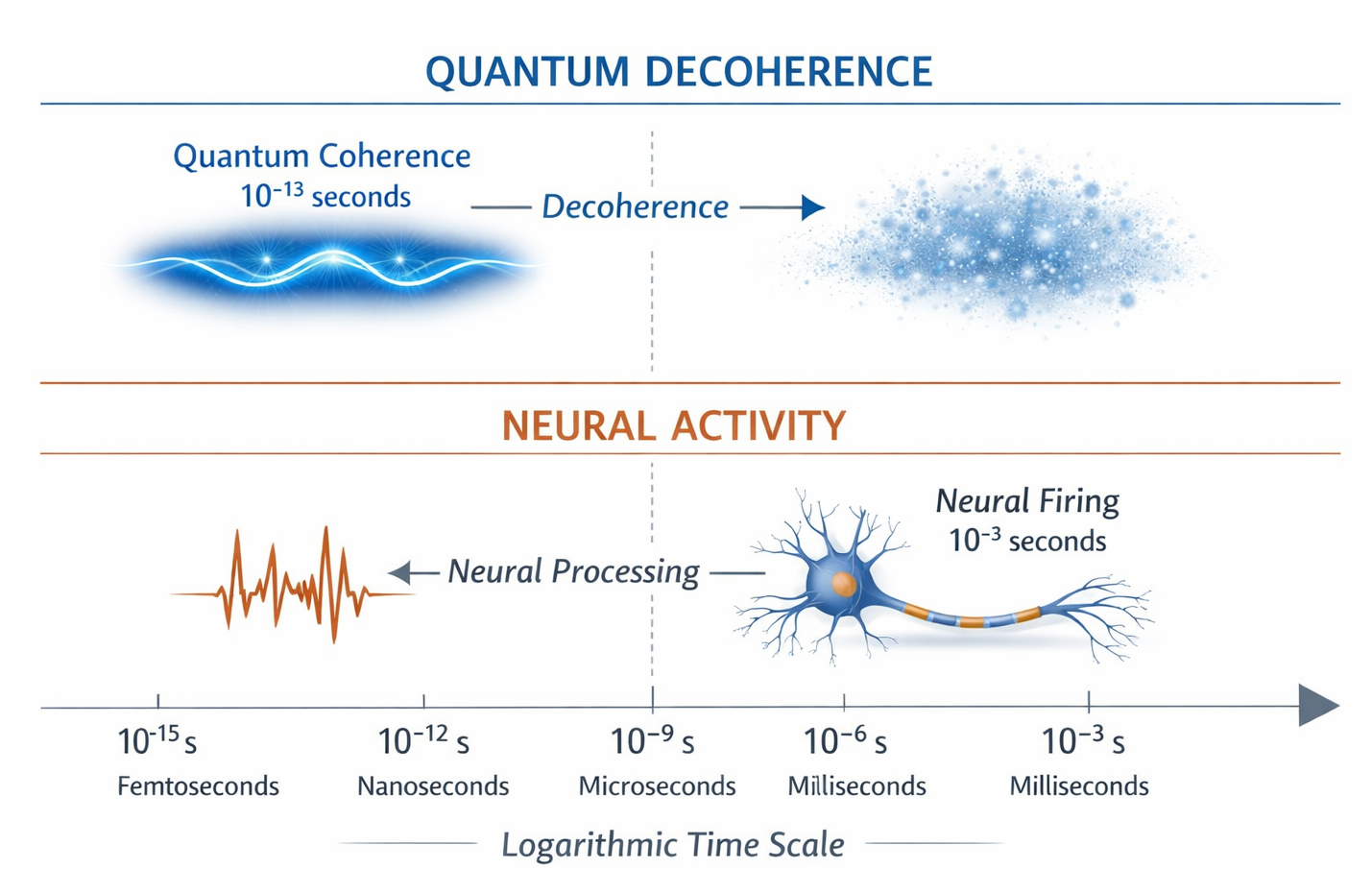
The central challenge for any quantum brain theory is decoherence. Biological systems operate at physiological temperatures (~310 K) with abundant water molecules, ions, and thermal fluctuations. Tegmark (2000) estimated that quantum coherence times in neural microtubules would be on the order of 10⁻¹³ seconds—many orders of magnitude shorter than the timescale of neural processes (~10⁻³ seconds). However, subsequent work in quantum biology has demonstrated that quantum coherence can persist at biological temperatures in photosynthetic complexes, bird navigation systems, and enzyme catalysis (Lambert et al., 2013), suggesting that biological systems may have evolved mechanisms to shield or exploit quantum coherence. The magnitude of this timescale disparity—spanning roughly ten orders of magnitude—is illustrated in Figure 1.
2.2 Neuronal Microstructure and Potential Quantum Substrates
The neuron, the fundamental computational unit of the nervous system, contains several structural elements that have been proposed as quantum substrates. Microtubules are hollow cylindrical polymers composed of α/β-tubulin heterodimers arranged in a helical lattice with a diameter of ~25 nm. They form the cytoskeletal scaffold of neurons, are involved in axonal transport, and have been proposed as quantum processors due to their geometry, electrical properties, and the conformational dynamics of tubulin subunits (Hameroff & Penrose, 1996).
Neuronal membranes and ion channels have also been considered. Quantum tunneling has been proposed to play a role in olfactory transduction (Turin, 1996) and ion channel gating. Additionally, the synaptic cleft—the ~20 nm gap between pre- and post-synaptic membranes—presents a scale at which quantum effects in neurotransmitter release and receptor binding cannot be ruled out (Beck & Eccles, 1992). At the systems level, quantum field theories propose that brain water molecules form long-range quantum coherent domains, creating a distributed quantum information processing medium (Del Giudice et al., 2010).
3. Major Theoretical Frameworks
3.1 Orchestrated Objective Reduction (Orch OR)
The Orchestrated Objective Reduction hypothesis, proposed by mathematical physicist Roger Penrose and anesthesiologist Stuart Hameroff, is the most elaborated and debated quantum consciousness theory (Penrose, 1989; Hameroff & Penrose, 1996, 2014). The theory integrates two components: Penrose's proposal for a new, non-algorithmic form of quantum gravity collapse (Objective Reduction, OR) and Hameroff's identification of microtubules as the biological locus of quantum computation.
Penrose's argument begins with Gödel's incompleteness theorem, which demonstrates that any sufficiently powerful formal axiomatic system contains true statements that cannot be proven within the system. Penrose argues that human mathematicians can 'see' such truths intuitively, implying a cognitive capacity that exceeds any algorithmic (Turing-computable) process. He concludes that whatever physical process underlies this capacity must be non-computable, and proposes that this arises from a yet-undiscovered theory of quantum gravity in which superposed space-time geometries undergo objective collapse—Objective Reduction—at the Planck scale (Penrose, 1994).
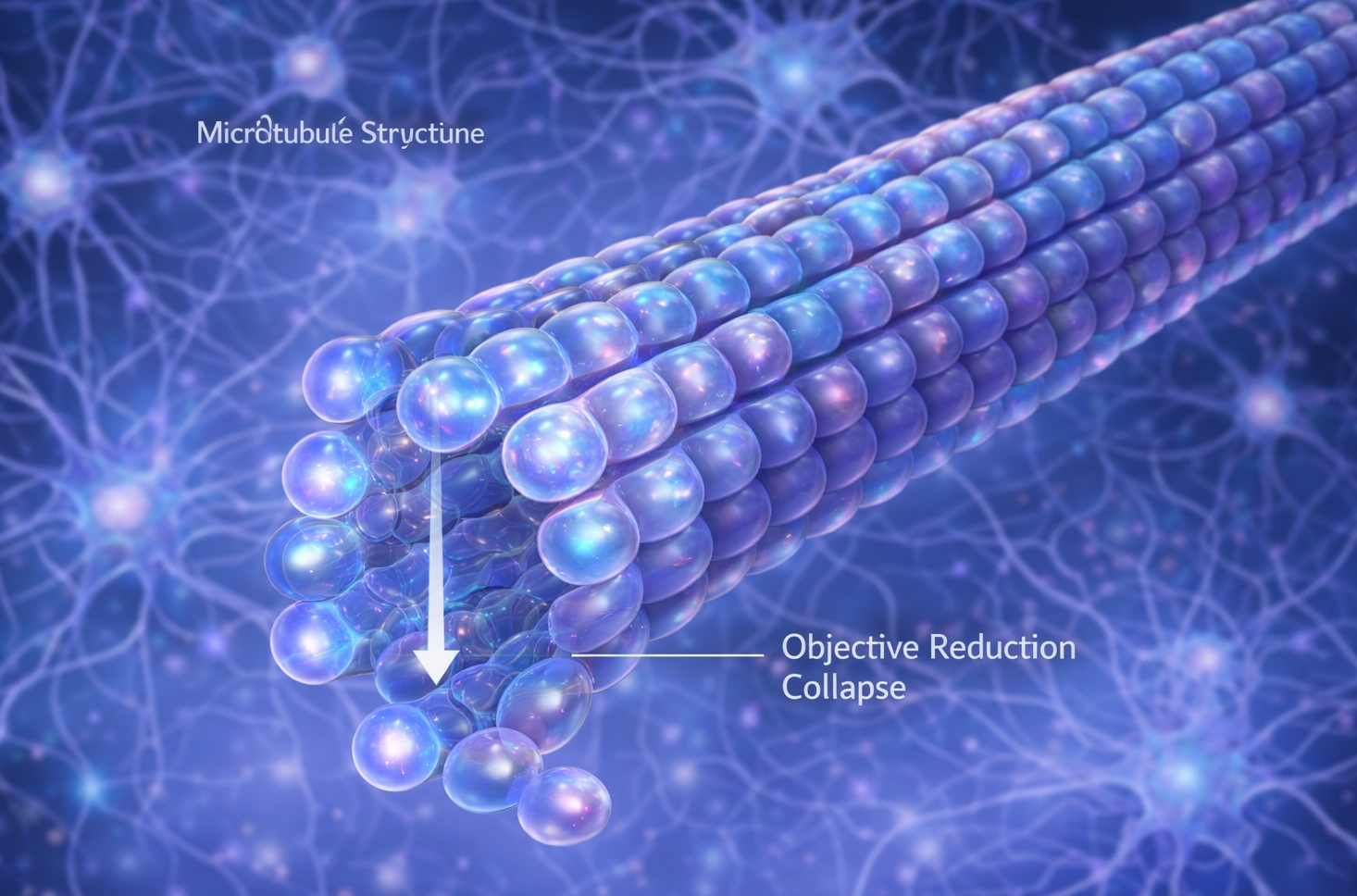
Hameroff proposed that microtubule networks in neurons are the site where OR events are 'orchestrated' by biological processes, including synaptic inputs and microtubule-associated proteins (MAPs). In this model, tubulin dimers exist in superpositions of two conformational states; the quantum computation proceeds until the superposition reaches a threshold determined by the quantum gravity criterion, at which point OR collapse occurs, producing moments of proto-conscious experience. Repeated OR events at approximately 40 Hz are proposed to correspond to gamma-frequency neural oscillations associated with conscious awareness (Hameroff & Penrose, 2014).
Recent updates to Orch OR have incorporated findings from quantum biology and anesthesiology. Hameroff and Penrose (2014) cite evidence that anesthetic gases bind to hydrophobic pockets in tubulin and cytoskeletal proteins, disrupting quantum processes and abolishing consciousness, as consistent with the theory. The model has also been reformulated to propose that quantum vibrations in microtubules occur at terahertz frequencies and that consciousness arises from resonances across multiple scales of the nervous system. The essential architecture of this model is schematized in Figure 2.
3.2 Stapp's Quantum Mind Theory
Henry Stapp (2007, 2017) developed a quantum mind theory grounded in the Copenhagen-Heisenberg interpretation of quantum mechanics, specifically Heisenberg's conception of the wave function as representing potentialities in nature rather than physical realities. Stapp argues that the mind plays a physically efficacious role in collapsing the quantum state of the brain, thereby coupling mental and physical reality at the quantum level. In Stapp's model, the brain is described as a quantum system whose state evolves according to the Schrödinger equation, generating a superposition of possible neural states. A conscious observation—a mental event corresponding to William James's 'stream of consciousness'—constitutes a quantum measurement that collapses this superposition. Crucially, the Quantum Zeno Effect (QZE) plays a central explanatory role: rapid, repeated mental observations can hold a neural pattern in place, influencing motor actions and thought processes.
3.3 Quantum Field Theory of Brain and Consciousness
Hiroomi Umezawa (1993) proposed that the brain functions as a quantum field system in which memory is stored as long-range ordered quantum states of cortical tissue. This framework was developed by Vitiello (1995, 2001) into a quantum field theory (QFT) of consciousness in which the brain is modeled as an open quantum system exchanging energy with its environment. The breakdown of temporal symmetry (time-reversal asymmetry) inherent in open quantum systems provides a physical basis for the temporal order of consciousness and the directionality of memory formation. A key concept is the coherent condensation of bosons (quanta of the quantum fields corresponding to cortical modes) into a macroscopic quantum state, analogous to Bose-Einstein condensation. Del Giudice, Preparata, and Vitiello (1988) proposed that the electric dipole vibrations of water molecules in the brain could form quantum coherent domains of ~100 nm diameter, acting as a medium for quantum information processing across neural tissue.
3.4 Holonomic Brain Theory
Karl Pribram, a neuroscientist, collaborated with physicist David Bohm to develop the holonomic brain theory (Pribram, 1991; Bohm & Hiley, 1993). This framework proposes that the brain processes information using principles analogous to holography: information is encoded in interference patterns distributed across neural networks, rather than localized to specific sites. Bohm's implicate order—a non-local, quantum-level underpinning of reality—is proposed as the ontological foundation of consciousness. Neurophysiological support for this framework comes from Pribram's own research on the distributed nature of memory storage (Lashley's equipotentiality principle) and from slow wave potentials recorded in cortical tissue, which Pribram interpreted as holographic interference patterns.
4. Empirical Evidence: Challenges and Support
4.1 The Decoherence Challenge
The most robust criticism of quantum mind theories is the decoherence challenge. Tegmark (2000) performed detailed calculations showing that quantum superpositions in neural microtubules would decohere in approximately 10⁻¹³ seconds due to thermal interactions with the surrounding ionic medium. This is vastly shorter than the ~10⁻³ second timescales of neural processes, rendering quantum coherence computationally irrelevant. These calculations have been widely cited as a decisive argument against quantum consciousness theories. Proponents of Orch OR have offered several responses. Hameroff (2013) argues that the interior of microtubules may be sufficiently isolated from thermal noise due to ordered water layers and lattice vibrations. Furthermore, the discovery of quantum coherence in warm biological systems—most notably in the Fenna-Matthews-Olson (FMO) complex of photosynthetic bacteria at physiological temperatures (Engel et al., 2007)—has established that biological systems can sustain quantum coherence at 300 K, though the relevance of this finding to neural quantum coherence is debated (Fleming et al., 2011).
4.2 Quantum Biology: Relevant Findings
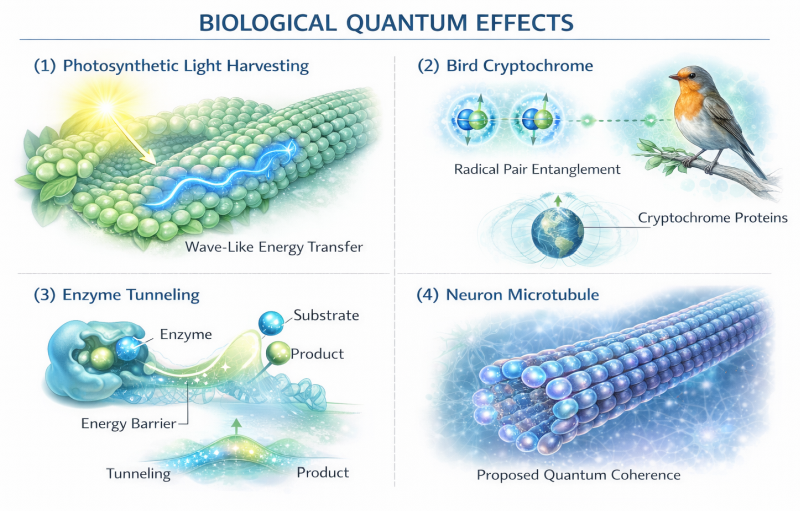
The nascent field of quantum biology has documented quantum effects in several biological processes, providing indirect support for the plausibility—if not direct evidence—of quantum effects in neural function. Photosynthetic light harvesting in plants and bacteria involves quantum coherent energy transfer, enabling near-perfect efficiency (Engel et al., 2007; Scholes et al., 2017). Avian magnetic navigation relies on radical-pair quantum entanglement in cryptochrome proteins in the bird retina (Ritz et al., 2000; Hore & Mouritsen, 2016). Enzyme catalysis exploits quantum tunneling of protons and electrons to accelerate chemical reactions (Scrutton et al., 2012).
These findings establish that warm, wet biological systems can be 'quantum machines,' harnessing quantum mechanical effects for biological function (McFadden & Al-Khalili, 2014). However, critics note that quantum coherence in photosynthesis is spatially confined, short-lived, and does not involve the kind of sustained, large-scale quantum computation proposed by Orch OR (Tegmark, 2015). A more detailed comparison is instructive. In the FMO complex, quantum coherence operates over spatial scales of a few nanometers and persists for hundreds of femtoseconds—sufficient to guide energy transfer across a protein complex of ~10 nm diameter. Orch OR, by contrast, requires coherent superpositions to be maintained across microtubule networks spanning micrometers and lasting on the order of tens of milliseconds. This represents a difference of roughly three to four orders of magnitude in both spatial extent and temporal duration. There is, at present, no identified biological mechanism that could bridge this gap. While ordered water layers within the microtubule lumen have been proposed as a shielding mechanism, the physical plausibility of this proposal on the required timescales has not been quantitatively demonstrated. Proponents of Orch OR must therefore either identify a novel isolation mechanism or revise the timescale requirements of the theory. This remains, in the authors' view, the single most critical unresolved challenge for the physical quantum mind hypothesis. Nevertheless, these discoveries have substantially broadened scientific openness to quantum effects in biology, and the comparison across systems is summarized in Figure 3.
4.3 Experimental Evidence in Neural Systems
Direct experimental evidence for quantum effects in neural computation remains limited and contested. Craddock et al. (2017) reported computational evidence that anesthetic binding to tubulin disrupts quantum states, consistent with Orch OR predictions regarding anesthesia. Several groups have measured MHz-to-THz vibrations in microtubules using Raman spectroscopy and atomic force microscopy (Pokorný et al., 2015), finding resonance patterns consistent with quantum mechanical lattice vibrations. Bandyopadhyay and colleagues (Sahu et al., 2013) reported experimental evidence of quantum resonance in isolated microtubules, observing conductance in discrete steps suggestive of quantum energy level transitions. However, these findings await independent replication. On a different experimental approach, quantum cognition researchers (Pothos & Busemeyer, 2009; Khrennikov, 2010) have demonstrated that quantum probability models provide better fits to human behavioral data in cognitive tasks (conjunction fallacy, order effects in surveys, preference reversals) than classical Bayesian models, suggesting that quantum formalism captures something fundamental about cognition, though not necessarily at the physical quantum level.
4.4 Neuroimaging and Oscillatory Correlates
Gamma-band oscillations (30–80 Hz) in the cortex have long been associated with conscious awareness, attention, and working memory (Fries, 2015). Orch OR proposes that these oscillations reflect OR events in microtubule networks. While the correlation between gamma oscillations and consciousness is well established (Dehaene et al., 2006), the mechanistic link to quantum collapse remains speculative. Advanced neuroimaging techniques including magnetoencephalography (MEG), high-density EEG, and emerging quantum sensing approaches using nitrogen-vacancy (NV) centers in diamond (Barry et al., 2020) are providing new windows into neural electromagnetic dynamics at finer spatial and temporal scales.
5. Quantum Cognition: A Separate Framework
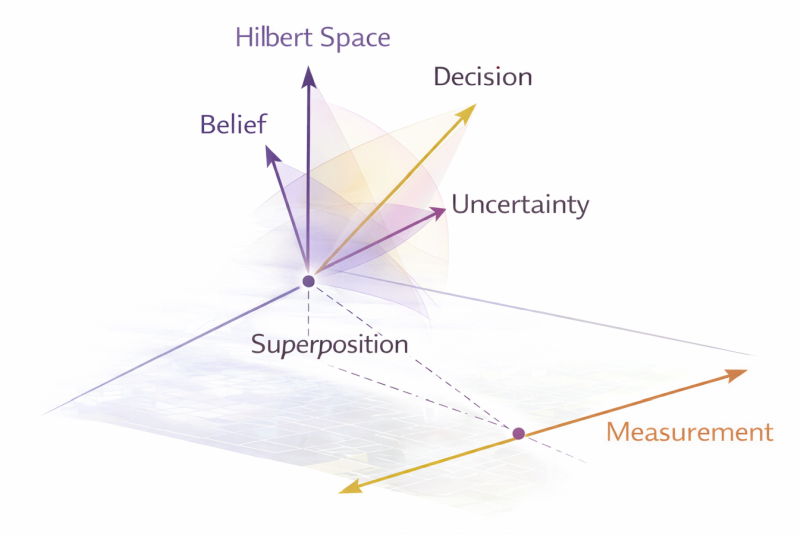
Quantum cognition is a research program that applies the mathematical formalism of quantum theory—specifically Hilbert space representations, non-commutative probability, and the Born rule—to model cognitive phenomena, without necessarily claiming that the brain is a quantum computer (Busemeyer & Bruza, 2012; Pothos & Busemeyer, 2009). This distinction is crucial: quantum cognition is an abstract computational/representational theory, not a claim about quantum physics in neurons.
The quantum cognition framework has achieved notable empirical success. It provides natural accounts of the conjunction fallacy (Tversky & Kahneman, 1983)—where people judge the probability of A and B as greater than the probability of B alone—by modeling beliefs in superposition states. It explains order effects in survey responses (asking question A first changes the probability distribution for question B) through the non-commutativity of quantum operators. It models the disjunction effect in decision theory—where people violate the Sure-Thing Principle—through quantum interference (Busemeyer et al., 2011).
Khrennikov (2010) has developed a broad mathematical framework applying p-adic and quantum-like structures to cognitive modeling, while Atmanspacher and Filk (2010) have proposed temporal non-locality in cognition as a quantum-like phenomenon. The success of quantum probability models in cognitive science has led some theorists to propose that cognitive systems might be 'quantum-like' for functional reasons—perhaps because quantum probability provides optimal strategies under certain computational constraints—regardless of whether the physical substrate implements quantum mechanics (Khrennikov, 2015). The representational structure of quantum cognition models is illustrated in Figure 4.
6. Discussion
6.1 Critical Evaluation and Ongoing Debates
The quantum mind hypothesis occupies an unusual position in science: it is theoretically motivated by deep puzzles (the hard problem of consciousness, the non-algorithmic nature of mathematical insight) and empirically challenging to test. The strongest scientific criticism holds that: (a) decoherence effectively eliminates quantum coherence from macroscopic neural processes; (b) classical neural network models provide sufficient explanatory power for known cognitive functions; and (c) quantum gravity effects at the neural scale are infinitesimally small and unmeasurable with current technology (Tegmark, 2000; Koch & Hepp, 2006).
Defenders of quantum mind theories counter that: (a) the hard problem of consciousness is not solved by classical neuroscience; (b) quantum biology demonstrates that biological systems can harness quantum effects; (c) Orch OR makes specific empirical predictions (regarding anesthesia, microtubule vibrations, gamma oscillations) that are testable; and (d) the dismissal of quantum mind theories often relies on extrapolations from physics that may not apply to the specific organization of biological neural networks (Hameroff & Penrose, 2014; Penrose, 2014).
A critical and currently underexplored dimension of the quantum mind debate is its relationship to mainstream neuroscientific theories of consciousness. Two dominant frameworks deserve explicit engagement. Global Workspace Theory (GWT; Baars, 1988; Dehaene et al., 2006) proposes that consciousness arises from the broadcasting of information across a "global workspace" of widely distributed cortical areas, enabling integration and flexible access. Integrated Information Theory (IIT; Tononi, 2004, 2008) proposes that consciousness is identical to integrated information (Φ), a quantity that measures the degree to which a system generates more information than the sum of its parts. These theories make no appeal to quantum mechanics and have garnered substantial empirical support from neuroimaging and lesion studies.
Drawing together the foregoing analysis, the authors offer the following synthesis. Orch OR remains the most empirically specific quantum consciousness theory, making falsifiable predictions regarding anesthesia mechanisms, microtubule resonances, and gamma oscillations. Its primary strength is its integration of physics, biology, and phenomenology into a unified framework. Its most significant unresolved weakness is the decoherence problem: the ordered-water shielding argument has not been quantitatively validated, and the coherence timescales and spatial scales required exceed those documented in any biological quantum system by several orders of magnitude. Stapp's theory elegantly addresses the role of intentionality and avoids the substrate specificity problem, but relies on a contested (Copenhagen) interpretation of quantum mechanics and has been criticized for circularity. The quantum field theories of Umezawa and Vitiello provide a mathematically sophisticated framework but have few direct experimental predictions at the neural level. Holonomic brain theory offers a compelling account of distributed memory but invokes quantum ontology at a level too abstract to generate testable predictions. Quantum cognition is, in the authors' assessment, the most experimentally robust of the frameworks reviewed, with a growing body of behavioral evidence; its primary limitation is its agnosticism about physical substrate, which limits its explanatory scope regarding phenomenal consciousness per se. Table 1 summarizes this comparative assessment.
| Theory | Biological Substrate | Testability | Decoherence Handling | Compatibility with Neuroscience | Key Unresolved Weakness |
|---|---|---|---|---|---|
| Orch OR | Neuronal microtubules | Moderate | Ordered water shielding (unvalidated) | Partial (gamma oscillations) | Decoherence timescale gap |
| Stapp's QM Mind | Whole brain | Low | Not directly addressed | Accounts for intentionality | Contested Copenhagen interpretation |
| QFT (Umezawa/Vitiello) | Brain water; cortical fields | Low | Macro-scale condensation | Temporal ordering of memory | Few direct predictions |
| Holonomic Brain Theory | Distributed networks | Low | Not addressed | Consistent with distributed memory | Quantum role ontological |
| Quantum Cognition | None (abstract) | High | N/A | High compatibility | No account of phenomenal consciousness |
6.2 Philosophical Implications
If quantum processes contribute to consciousness, several profound philosophical implications follow. First, the mind may be fundamentally non-algorithmic, with implications for artificial intelligence and the limits of computational simulation of consciousness (Penrose, 1994). Second, quantum non-locality could provide a physical basis for the unity of consciousness—the binding of distributed neural representations into a single, unified experience (Stapp, 2007). Third, quantum indeterminism might ground genuine free will, escaping the deterministic closure of classical physics (Eccles, 1994). Finally, the observer's role in quantum measurement, if it involves consciousness, blurs the boundary between objective physical reality and subjective experience in ways that challenge Cartesian dualism (Wigner, 1961).
6.3 Future Research Directions
Several research directions hold promise for empirically resolving debates about quantum brain function. (1) Quantum sensing of neural activity: Nitrogen-vacancy center magnetometers in diamond can detect magnetic fields at the cellular level with sub-millisecond temporal resolution, potentially detecting quantum-coherent electromagnetic oscillations in neural tissue (Barry et al., 2020). (2) Single-microtubule quantum optics: Experiments probing quantum coherence in isolated microtubules under physiological conditions using femtosecond spectroscopy could directly test the decoherence timescales relevant to Orch OR. (3) Quantum-sensitive anesthesia studies: Systematic variation of anesthetic agents with known binding affinities to tubulin versus other targets, combined with EEG and consciousness measures, could test specific Orch OR predictions. (4) Quantum cognition paradigms: Further development of behavioral paradigms that distinguish quantum probability from classical Bayesian models could clarify the status of quantum-like cognition. (5) Integrated theoretical frameworks: Theories that integrate quantum information theory with network neuroscience could bridge the gap between quantum physics and systems-level neural dynamics.
7. Conclusions
The quantum brain and mind hypothesis represents one of the most audacious and intellectually fertile propositions in contemporary science. Despite significant—and well-founded—scientific skepticism, it has generated rich theoretical frameworks, motivated novel experimental approaches, and forced a deeper interrogation of the nature of consciousness and its relationship to physical reality. The decoherence challenge remains formidable, but quantum biology has established that biological systems are not uniformly 'quantum-classical divides': nature has found ways to exploit quantum effects even in warm, noisy environments.
The theoretical landscape has matured considerably since Penrose's initial proposals, with multiple distinct frameworks offering different accounts of how quantum mechanics might contribute to mind. Quantum cognition, in particular, has achieved empirical successes independent of claims about physical quantum processes in neurons, suggesting that quantum mathematical structure captures something important about the architecture of cognition.
The path forward requires novel experimental technologies, rigorous theoretical development, and productive dialogue between physicists, neuroscientists, philosophers of mind, and cognitive scientists. The quantum mind hypothesis may ultimately be vindicated, refuted, or—most likely—transformed into something more nuanced than its current formulations. In any case, the pursuit of this question pushes the boundaries of our understanding of both quantum physics and the nature of mind, making it among the most compelling scientific frontiers of the twenty-first century.
Key Insights from the Article
References
- Atmanspacher H, Filk T. A proposed test of temporal nonlocality in bistable perception. J Math Psychol. 2010;54(3):314–321. doi:10.1016/j.jmp.2009.12.001
- Barry JF, Schloss JM, Bauch E, et al. Sensitivity optimization for NV-diamond magnetometry. Rev Mod Phys. 2020;92(1):015004. doi:10.1103/RevModPhys.92.015004
- Beck F, Eccles JC. Quantum aspects of brain activity and the role of consciousness. Proc Natl Acad Sci USA. 1992;89(23):11357–11361. doi:10.1073/pnas.89.23.11357
- Bohm D, Hiley BJ. The Undivided Universe: An Ontological Interpretation of Quantum Theory. Routledge; 1993.
- Busemeyer JR, Bruza PD. Quantum Models of Cognition and Decision. Cambridge University Press; 2012.
- Busemeyer JR, Pothos EM, Franco R, Trueblood JS. A quantum theoretical explanation for probability judgment errors. Psychol Rev. 2011;118(2):193–218. doi:10.1037/a0022542
- Chalmers DJ. Facing up to the problem of consciousness. J Conscious Stud. 1995;2(3):200–219.
- Craddock TJA, Friesen D, Mane J, Hameroff S, Tuszynski JA. The feasibility of coherent energy transfer in microtubules. J R Soc Interface. 2017;14(131):20170415. doi:10.1098/rsif.2017.0415
- Dehaene S, Changeux JP, Nacache L. Experimental and theoretical approaches to conscious processing. Neuron. 2006;70(2):200–227. doi:10.1016/j.neuron.2011.03.018
- Del Giudice E, Preparata G, Vitiello G. Water as a free electric dipole laser. Phys Rev Lett. 1988;61(9):1085–1088. doi:10.1103/PhysRevLett.61.1085
- Del Giudice E, Spinetti PR, Tedeschi A. Water dynamics at the root of metamorphosis in living organisms. Water. 2010;2(3):566–586. doi:10.3390/w2030566
- Eccles JC. How the Self Controls Its Brain. Springer-Verlag; 1994.
- Engel GS, Calhoun TR, Read EL, et al. Evidence for wavelike energy transfer through quantum coherence in photosynthetic systems. Nature. 2007;446(7137):782–786. doi:10.1038/nature05678
- Fleming GR, Huelga SF, Plenio MB. Focus on quantum effects and noise in biomolecular systems. New J Phys. 2011;13(11):115002. doi:10.1088/1367-2630/13/11/115002
- Fries P. Rhythms for cognition: Communication through coherence. Neuron. 2015;88(1):220–235. doi:10.1016/j.neuron.2015.09.034
- Hameroff SR. Ultimate Computing: Biomolecular Consciousness and Nanotechnology. Elsevier; 1987.
- Hameroff SR. Quantum cognition and brain microtubules. In: Bruza P, Busemeyer J, eds. Quantum Interaction. Springer; 2013:12–29.
- Hameroff S, Penrose R. Orchestrated reduction of quantum coherence in brain microtubules: A model for consciousness. Math Comput Simul. 1996;40(3–4):453–480. doi:10.1016/0378-4754(96)80476-9
- Hameroff S, Penrose R. Consciousness in the universe: A review of the 'Orch OR' theory. Phys Life Rev. 2014;11(1):39–78. doi:10.1016/j.plrev.2013.08.002
- Hore PJ, Mouritsen H. The radical-pair mechanism of magnetoreception. Annu Rev Biophys. 2016;45:299–344. doi:10.1146/annurev-biophys-032116-094545
- Khrennikov A. Ubiquitous Quantum Structure: From Psychology to Finance. Springer; 2010.
- Khrennikov A. Quantum-like brain: Interference of minds. BioSystems. 2015;105(3):101–109. doi:10.1016/j.biosystems.2011.05.012
- Koch C, Hepp K. Quantum mechanics in the brain. Nature. 2006;440(7084):611–612. doi:10.1038/440611a
- Lambert N, Chen YN, Cheng YC, Li CM, Chen GY, Nori F. Quantum biology. Nat Phys. 2013;9(1):10–18. doi:10.1038/nphys2474
- McFadden J, Al-Khalili J. Life on the Edge: The Coming of Age of Quantum Biology. Crown Publishers; 2014.
- Penrose R. The Emperor's New Mind: Concerning Computers, Minds and the Laws of Physics. Oxford University Press; 1989.
- Penrose R. Shadows of the Mind: A Search for the Missing Science of Consciousness. Oxford University Press; 1994.
- Pokorný J, Pokorný J, Kobilková J, Jandová A, Vrba J. Biophysical cancer transformation pathway. Electromagn Biol Med. 2015;34(4):366–376. doi:10.3109/15368378.2014.927581
- Pothos EM, Busemeyer JR. A quantum probability explanation for violations of 'rational' decision theory. Proc R Soc B. 2009;276(1665):2171–2178. doi:10.1098/rspb.2009.0121
- Pribram KH. Brain and Perception: Holonomy and Structure in Figural Processing. Lawrence Erlbaum; 1991.
- Ritz T, Adem S, Schulten K. A model for photoreceptor-based magnetoreception in birds. Biophys J. 2000;78(2):707–718. doi:10.1016/S0006-3495(00)76629-X
- Sahu S, Ghosh S, Hirata K, Fujita D, Bandyopadhyay A. Multi-level memory-switching properties of a single brain microtubule. Appl Phys Lett. 2013;102(12):123701. doi:10.1063/1.4793995
- Scholes GD, Fleming GR, Chen LX, et al. Using coherence to enhance function in chemical and biophysical systems. Nature. 2017;543(7647):647–656. doi:10.1038/nature21425
- Scrutton NS, Hay S, Sutcliffe MJ. Enzyme-catalysed H-transfer reactions: Tunnelling and the role of the enzyme. Biochem Soc Trans. 2012;40(3):560–564. doi:10.1042/BST20120008
- Stapp HP. Mind, Matter and Quantum Mechanics. 3rd ed. Springer; 2007.
- Stapp HP. Quantum Theory and Free Will: How Mental Intentions Translate to Bodily Actions. Springer; 2017.
- Tegmark M. Importance of quantum decoherence in brain processes. Phys Rev E. 2000;61(4):4194–4206. doi:10.1103/PhysRevE.61.4194
- Tegmark M. Consciousness as a state of matter. Chaos Solitons Fractals. 2015;76:238–270. doi:10.1016/j.chaos.2015.03.014
- Turin L. A spectroscopic mechanism for primary olfactory reception. Chem Senses. 1996;21(6):773–791. doi:10.1093/chemse/21.6.773
- Tversky A, Kahneman D. Extensional versus intuitive reasoning: The conjunction fallacy in probability judgment. Psychol Rev. 1983;90(4):293–315. doi:10.1037/0033-295X.90.4.293
- Umezawa H. Advanced Field Theory: Micro, Macro, and Thermal Physics. American Institute of Physics; 1993.
- Vitiello G. Dissipation and memory capacity in the quantum brain model. Int J Mod Phys B. 1995;9(8):973–989. doi:10.1142/S0217979295000380
- Vitiello G. My Double Unveiled: The Dissipative Quantum Model of Brain. John Benjamins; 2001.
- Von Neumann J. Mathematische Grundlagen der Quantenmechanik. Springer; 1932.
- Wigner EP. Remarks on the mind-body question. In: Good IJ, ed. The Scientist Speculates. Heinemann; 1961:284–302.
- Zurek WH. Decoherence, einselection, and the quantum origins of the classical. Rev Mod Phys. 2003;75(3):715–775. doi:10.1103/RevModPhys.75.715
Authors hold copyright with no restrictions. This work is licensed under CC BY.