The free will debate has long been central to philosophy, connecting metaphysical questions of autonomy with issues of moral and legal responsibility. With the advent of neuroscience, this debate has shifted from speculative theorizing to empirical investigation. NeuroPhilosophy, pioneered by Patricia Churchland and others, provides a framework that integrates brain science with philosophical analysis, offering new ways to understand the nature of agency. This article presents a narrative review of key developments from 1983 to 2025, synthesizing findings from experimental neuroscience, philosophical theories, and recent interdisciplinary discussions in neuroethics and artificial intelligence. Special attention is given to Libet's readiness potential studies, predictive neuroimaging approaches, and alternative models such as stochastic accumulator frameworks. Beyond laboratory evidence, this review explores contemporary challenges including brain--computer interfaces, predictive AI, and their implications for law and society. The novelty of this work lies in proposing a "spectrum model of agency," which situates free will not as a binary condition but as a dynamic construct shaped by neural, social, and technological factors. By bridging empirical findings with normative philosophy, this review demonstrates how NeuroPhilosophy can reframe the free will debate, ensuring its relevance in the age of neurotechnology and global ethical concerns.
1. Introduction
The problem of free will has remained one of the most enduring and contested questions in philosophy. For centuries, thinkers have debated whether human beings are genuinely autonomous agents or whether our actions are fully determined by prior causes. Classical philosophical traditions, from Aristotle's emphasis on rational deliberation to Augustine's theological reflections on sin and grace, framed free will as central to ethics, responsibility, and human dignity. In the modern era, figures such as René Descartes, David Hume, and Immanuel Kant deepened the debate, linking freedom to dualism, empiricism, and moral autonomy.
However, the 20th century introduced a radical shift in this debate with the rise of neuroscience. Instead of treating free will purely as a metaphysical problem, researchers began investigating its neural underpinnings. The pioneering work of Benjamin Libet (1983) on the readiness potential demonstrated that measurable brain activity in the motor cortex occurred approximately 350 milliseconds before subjects reported conscious awareness of the intention to act. This finding suggested that unconscious neural processes precede conscious will. Later studies refined this timeline: Haggard and Eimer (1999) confirmed readiness potentials beginning up to 500 milliseconds before awareness, while Matsuhashi and Hallett (2008) showed that interruptions in motor intention could be detected as early as 1.2 seconds before subjects consciously noticed them.
The implications of these results became even more striking with the advent of functional magnetic resonance imaging (fMRI). Soon et al. (2008) reported that patterns of activity in the prefrontal and parietal cortex could predict a participant's binary choice (pressing a left or right button) up to 7--10 seconds before conscious awareness, with accuracy levels of ~60%, well above chance. Subsequent machine-learning approaches extended predictive accuracy further, with some models reaching 70--80% under controlled conditions (Haynes, 2011). These results suggested that unconscious brain processes may not merely initiate actions milliseconds before awareness but could shape decisions well in advance.
These neuroscientific findings ignited an intense debate across philosophy, neuroscience, and law: if neural processes determine actions before awareness, is free will merely an illusion? While some interpreted these studies as undermining the very notion of autonomous choice (Wegner, 2002), others argued that such experiments only address simple motor tasks and cannot be generalized to complex moral or deliberative decisions (Roskies, 2010). Importantly, Libet himself proposed the notion of "free won't," suggesting that while unconscious processes may initiate actions, conscious awareness could still exert a veto function.
This tension between traditional philosophical accounts and neuroscientific evidence gave rise to NeuroPhilosophy, a field pioneered by Patricia Churchland (1986) and further developed by Daniel Dennett (2003). NeuroPhilosophy does not reduce philosophy to neuroscience but instead treats brain science as indispensable for addressing questions of mind, agency, and moral responsibility. By integrating empirical findings with philosophical reasoning, it provides a framework to reinterpret free will in light of biological constraints and technological advances.
The stakes of this debate are not purely academic. The implications of free will touch nearly every dimension of human life. In law, responsibility and punishment presuppose the capacity for autonomous choice. In medicine, psychiatric disorders raise questions about diminished agency, as in cases of obsessive-compulsive disorder or Tourette's syndrome, where involuntary neural processes drive behavior. In technology, predictive algorithms and brain--computer interfaces (BCIs) challenge the boundaries of human control. As artificial intelligence increasingly interacts with human decision-making, the question of whether human autonomy is robust or fragile acquires unprecedented urgency (Roskies, 2021).
Importantly, contemporary discourse suggests that free will may not be an "all-or-nothing" property. Instead, it can be conceived as a spectrum of agency, shaped by interactions between neural mechanisms, environmental contexts, and social institutions. This spectrum model reframes free will as a dynamic construct rather than a binary condition. In this sense, free will is not abolished by neuroscience but reconceived within a multidimensional framework that accounts for both biological determination and the emergent capacities of complex systems.
This article aims to provide a comprehensive review of the intersection between NeuroPhilosophy and free will. It begins by tracing the historical and philosophical foundations of the debate, before turning to key neuroscientific experiments that have challenged traditional notions of agency. It then examines competing neurophilosophical interpretations, from eliminativist to compatibilist accounts, and addresses contemporary challenges arising from AI, BCIs, and legal responsibility. Finally, the article considers the ethical and societal implications of these debates, proposing a spectrum model of agency as a unifying framework. By bridging philosophy, neuroscience, and technology, this review underscores the enduring relevance of the free will debate in the 21st century.
2. Historical and Philosophical Background
The debate over free will is as old as philosophy itself. Long before neuroscience introduced empirical tools to study decision-making, philosophers wrestled with the tension between human autonomy and causal determinism. To situate the contemporary neurophilosophical debate, it is necessary to revisit its intellectual roots, beginning in antiquity, moving through medieval theology, early modern philosophy, and Enlightenment science, before arriving at the naturalistic frameworks that prepared the ground for contemporary neuroscience.
2.1 Ancient and Medieval Roots
In ancient Greek philosophy, the question of freedom was tied to rationality and virtue. Aristotle (384--322 BCE), in his Nicomachean Ethics, distinguished between voluntary and involuntary actions, arguing that moral responsibility requires the ability to act in accordance with reason. Freedom, in this sense, was not the absence of causation but the alignment of one's actions with rational deliberation. The Stoics, however, adopted a deterministic cosmology, believing that everything unfolds according to divine logos. Yet they maintained a form of compatibilism: although events are predetermined, individuals achieve freedom by assenting to fate with rational acceptance.
In the Christian tradition, Augustine of Hippo (354--430 CE) emphasized the theological stakes of free will. Augustine argued that free will was essential to moral responsibility and divine justice. Without it, sin and salvation would lose their meaning. Yet he also struggled with reconciling human freedom with God's omniscience, anticipating debates that would persist throughout medieval theology. Later, Thomas Aquinas (1225--1274) integrated Aristotelian rationality with Christian doctrine, defending free will as compatible with divine providence. For Aquinas, human beings act freely because their will is directed toward perceived goods, even if God ultimately sustains all creation.
2.2 Early Modern Philosophy
The Scientific Revolution transformed the debate by introducing mechanistic models of nature. René Descartes (1596--1650), in Meditations on First Philosophy, emphasized the distinction between res cogitans (thinking substance) and res extensa (extended substance). While the physical world was mechanistically determined, the soul was free and immaterial. Cartesian dualism thus preserved free will by placing it outside the deterministic realm of physics.
In contrast, Baruch Spinoza (1632--1677) rejected dualism and argued for a thoroughgoing determinism. For Spinoza, all events follow necessarily from the divine substance, and the sense of freedom arises only from ignorance of causes. Freedom, in his system, was redefined not as uncaused choice but as understanding the necessity of nature.
David Hume (1711--1776) advanced a compatibilist account. In An Enquiry Concerning Human Understanding, he argued that free will and determinism are not incompatible. Human freedom consists not in being uncaused but in the ability to act according to one's desires and intentions without external constraint.
Immanuel Kant (1724--1804), however, insisted that morality presupposes autonomy in a deeper sense. For Kant, freedom is the capacity to act according to moral law, which originates in reason itself rather than empirical causation. Although phenomena are governed by natural laws, the noumenal self exists beyond causal determinism, grounding moral responsibility.
2.3 Determinism and Mechanistic Views
The Enlightenment also gave rise to strong deterministic frameworks. Pierre-Simon Laplace (1749--1827) famously imagined a hypothetical intellect---later called Laplace's demon---that, knowing the position and momentum of every particle, could predict the future with absolute certainty. In such a universe, free will appeared as an illusion.
Arthur Schopenhauer (1788--1860) advanced a more pessimistic view, declaring that humans may do what they will but cannot will what they will. This formulation captured a deterministic constraint at the level of volition itself, anticipating contemporary debates about unconscious processes shaping conscious intentions.
2.4 From Metaphysics to Naturalism
By the 19th and early 20th centuries, the problem of free will increasingly shifted toward psychology and biology. William James (1842--1910) defended an indeterminist view in The Dilemma of Determinism, emphasizing the lived experience of choice. For James, belief in free will had pragmatic value, fostering hope and responsibility. His perspective anticipated contemporary pragmatic and evolutionary approaches.
The rise of Darwinian evolution also reframed human agency within the framework of natural selection. Behavior was understood as adaptive, and freedom became linked to flexibility and problem-solving capacities rather than metaphysical independence. Sigmund Freud (1856--1939), in contrast, argued that unconscious drives shape much of human behavior, undermining traditional notions of autonomy.
By the mid-20th century, the debate was primed for the emergence of neuroscience. With the discovery of neural correlates of decision-making, the question of free will moved decisively from abstract metaphysics to empirical science. Philosophers such as Gilbert Ryle, with his critique of Cartesian dualism in The Concept of Mind (1949), paved the way for naturalistic accounts of mind and agency. Later, Patricia Churchland's Neurophilosophy (1986) explicitly called for philosophy to engage neuroscience, marking the beginning of a new era.
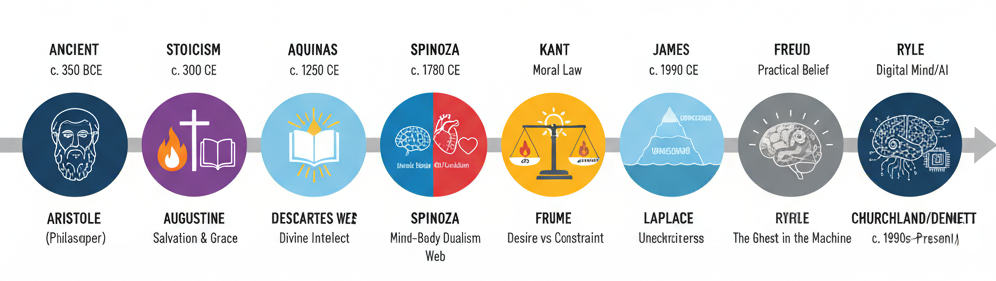
Table 1. Timeline of Major Perspectives on Free Will
| Period | Key Thinkers | Core Idea of Free Will | Orientation |
|---|---|---|---|
| Ancient Greece (4th c. BCE) | Aristotle | Voluntary actions guided by rational deliberation | Proto-Compatibilism |
| Stoic Philosophy (3rd c. BCE) | Chrysippus, Epictetus | Everything determined by divine logos; freedom = rational acceptance | Compatibilism |
| Late Antiquity (4th-5th c.) | Augustine | Free will essential for sin/salvation; tension with divine omniscience | Theological Libertarianism |
| Medieval Scholasticism (13th c.) | Aquinas | Free will compatible with God's providence; will seeks the good | Theological Compatibilism |
| Early Modern (17th c.) | Descartes | Soul (res cogitans) is immaterial and free; body mechanistic | Dualist Libertarianism |
| Early Modern (17th c.) | Spinoza | Determinism: freedom is understanding necessity | Hard Determinism |
| Enlightenment (18th c.) | Hume | Freedom = acting according to desires without external constraint | Compatibilism |
| Enlightenment (18th c.) | Kant | Freedom = autonomy of moral law beyond causal determinism | Libertarian Rationalism |
| Enlightenment Science (18th-19th c.) | Laplace | Universe is mechanistically determined (Laplace's Demon) | Hard Determinism |
| 19th c. | Schopenhauer | "Man can do what he wills, but cannot will what he wills" | Volitional Determinism |
| Pragmatism (19th c.) | William James | Free will as practical belief fostering responsibility | Pragmatic Indeterminism |
| Psychoanalysis (20th c.) | Freud | Unconscious drives undermine conscious autonomy | Psychological Determinism |
| 20th c. Analytic | Ryle | Critique of dualism; mind as behavior/disposition | Naturalistic Compatibilism |
| Late 20th c. | Churchland, Dennett | Neurophilosophy: free will as emergent property of brain systems | Neurophilosophical Compatibilism |
3. Neuroscientific Foundations of the Free Will Debate
The advent of neuroscience in the late twentieth century transformed the free will debate from a largely metaphysical question into an empirical one. By directly measuring neural activity associated with decision-making, researchers challenged the notion that conscious intention is the true initiator of voluntary action. Several key experimental paradigms, ranging from electroencephalography (EEG) to functional magnetic resonance imaging (fMRI), have fueled the controversy. This section reviews foundational studies, competing interpretations, and alternative models, highlighting the extent to which neuroscience informs---and complicates---the philosophical understanding of free will.
3.1 Libet's Experiments and the Readiness Potential
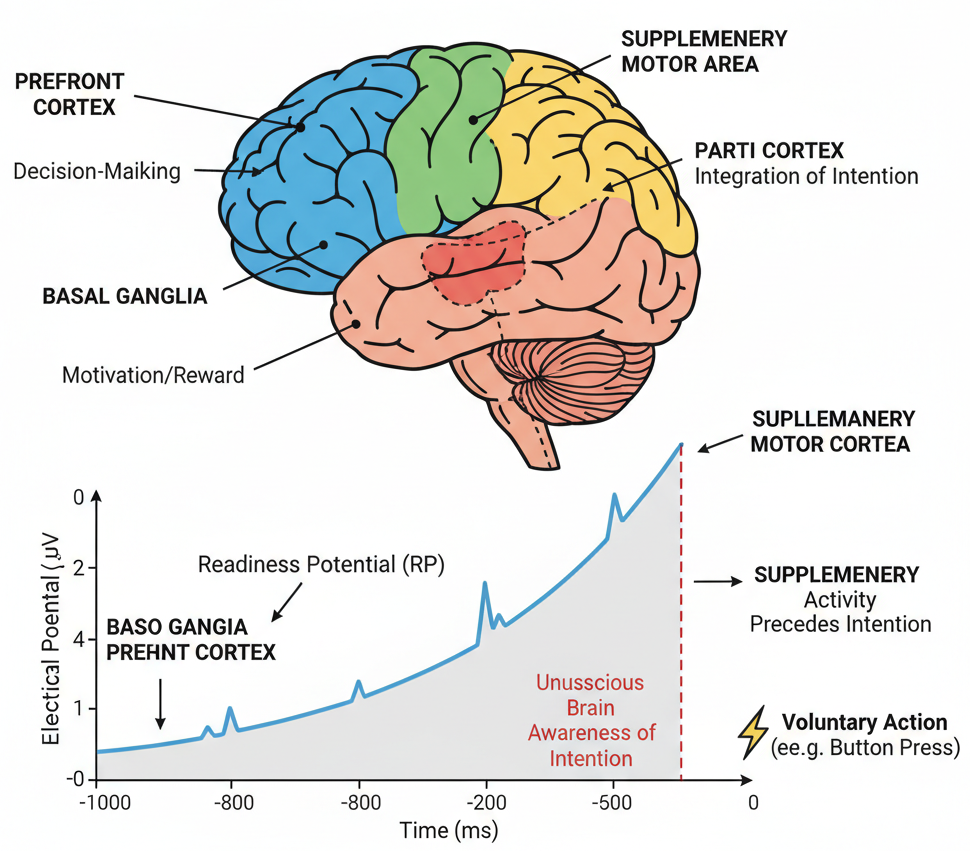
The most influential series of experiments on free will were conducted by Benjamin Libet in the early 1980s. Libet and colleagues (1983) asked participants to perform a simple motor task, such as flexing their wrist at a time of their choosing, while monitoring brain activity via EEG. Crucially, participants reported the moment they became consciously aware of the urge to act by referencing the position of a dot on a specially designed clock.
The results were striking. Libet found that a slow buildup of neural activity, termed the readiness potential (RP), began on average 350 milliseconds before the reported moment of conscious intention (W-time). Since the readiness potential is localized in motor-related brain areas, Libet interpreted it as evidence that the brain "decides" before the conscious mind does. Conscious will, in this interpretation, does not initiate voluntary acts but is informed of them after the brain has already begun preparing movement.
These findings appeared to undermine traditional notions of free will. If the brain initiates an action before conscious awareness, then conscious will might be an epiphenomenon---a byproduct of neural processes rather than their cause. Libet, however, did not conclude that free will is an illusion. Instead, he proposed a compromise: while unconscious processes may initiate actions, consciousness retains a "veto power" or "free won't." In other words, conscious awareness might not start an action but can still suppress it before execution.
Subsequent studies replicated and extended Libet's findings. Haggard and Eimer (1999) confirmed the presence of readiness potentials hundreds of milliseconds before conscious awareness, while Matsuhashi and Hallett (2008) used auditory probes to show that motor preparation can be detected as early as 1.2 seconds before participants report an intention. Together, these results suggest that unconscious neural processes precede conscious awareness in action initiation, raising deep questions about the causal role of consciousness.
3.2 Extensions: fMRI and Predictive Models
While Libet relied on EEG, later researchers employed fMRI to examine whether more complex brain patterns could predict decisions. A landmark study by Soon et al. (2008) asked participants to press either a left or right button at a time of their choosing, while recording brain activity. Using multivariate pattern analysis, Soon and colleagues found that patterns of activity in the frontopolar cortex and parietal cortex predicted which button participants would choose up to 7--10 seconds before conscious awareness. Accuracy levels were modest---about 60%, but significantly above chance.
These results were groundbreaking, as they suggested that unconscious processes could shape not just the timing but also the content of decisions well before participants became aware of them. Haynes (2011) later reviewed evidence showing that machine learning applied to neuroimaging data could reach 70--80% accuracy in predicting simple binary decisions under controlled conditions.
However, these findings provoked sharp debate. Critics argued that predicting a choice with 60--70% accuracy does not imply determinism, since substantial variance remains unexplained. Moreover, the tasks studied were artificial and trivial (e.g., button presses) rather than meaningful, value-laden decisions. Thus, while these studies reveal that unconscious neural processes precede and shape awareness, it is unclear whether they generalize to morally significant choices.
3.3 Neural Correlates of Agency and Decision-Making
Beyond Libet-type paradigms, neuroscientists have explored broader neural correlates of agency. Voluntary action is typically associated with activity in the prefrontal cortex, supplementary motor area (SMA), basal ganglia, and parietal cortex. These areas support the integration of intention, motor planning, and execution.
For instance, studies on the SMA indicate its role in initiating internally generated movements. The prefrontal cortex, by contrast, supports higher-order decision-making and weighing of alternatives. Dopaminergic circuits in the basal ganglia are implicated in motivation and reinforcement learning, linking reward signals to action initiation. Together, these networks suggest that free will, if it exists, is not localized in a single brain region but emerges from distributed systems that integrate unconscious and conscious processes.
The sense of agency---the feeling of being the author of one's actions---also has identifiable neural correlates. Disturbances in these systems, such as in patients with schizophrenia, can produce delusions of control, where individuals attribute their actions to external forces. This underscores the point that agency is not a metaphysical given but a construct generated by specific neural mechanisms.
3.4 Critiques and Alternatives
Not all scholars accept Libet-style interpretations. Several critiques have emerged:
1. Task Simplicity: Libet's tasks involved trivial movements, not morally or socially significant decisions. Critics argue that free will concerns complex deliberations, not wrist flexions.
2. Timing Uncertainty: The method of reporting intention using a clock is prone to errors and subjective biases. The reported W-time may not accurately reflect the onset of conscious intention.
3. Noise Accumulation Models: Schurger et al. (2012) proposed that readiness potentials may not reflect pre-decision planning but rather the accumulation of spontaneous neural noise. On this model, when activity crosses a threshold, movement occurs, and conscious awareness lags behind.
4. Free Won't: Even if unconscious processes initiate action, consciousness may still exert a veto function, preserving some form of agency.
These critiques suggest that neuroscience does not decisively disprove free will but complicates our understanding of it. Rather than viewing consciousness as the sole initiator, it may be more accurate to describe it as a modulator of action, capable of influencing, shaping, or inhibiting processes that originate unconsciously.
Table 2. Key Neuroscientific Studies on Free Will
| Study | Method | Key Finding | Implication |
|---|---|---|---|
| Libet et al. (1983) | EEG | Readiness potential ~350 ms before conscious intention | Brain initiates action before awareness |
| Haggard & Eimer (1999) | EEG | RP precedes intention by ~500 ms | Confirms Libet's findings |
| Matsuhashi & Hallett (2008) | EEG + auditory probes | Action preparation up to 1.2 s before awareness | Conscious intention may lag far behind brain processes |
| Soon et al. (2008) | fMRI + MVPA | Activity in frontopolar cortex predicts decisions 7-10 s before awareness (~60% accuracy) | Unconscious prediction of choices |
| Haynes (2011) | fMRI + machine learning | Accuracy up to 70-80% in predicting simple choices | Suggests limited determinism |
| Schurger et al. (2012) | EEG modeling | RP reflects neural noise accumulation, not pre-decision planning | Challenges Libet's interpretation |
4. NeuroPhilosophy and Theories of Agency
The rise of neuroscience has not eliminated philosophical inquiry into free will but has instead forced it into a new register. NeuroPhilosophy, as articulated by Patricia Churchland (1986) and expanded by subsequent thinkers, provides a methodological framework that integrates empirical neuroscience with normative philosophical analysis. In the context of free will, NeuroPhilosophy offers competing interpretations of agency: some embrace reductionist determinism, others defend compatibilist reinterpretations, and still others emphasize pragmatic or evolutionary accounts. This section examines the main neurophilosophical approaches to agency and their implications for the free will debate.
4.1 Eliminativism and Hard Determinism
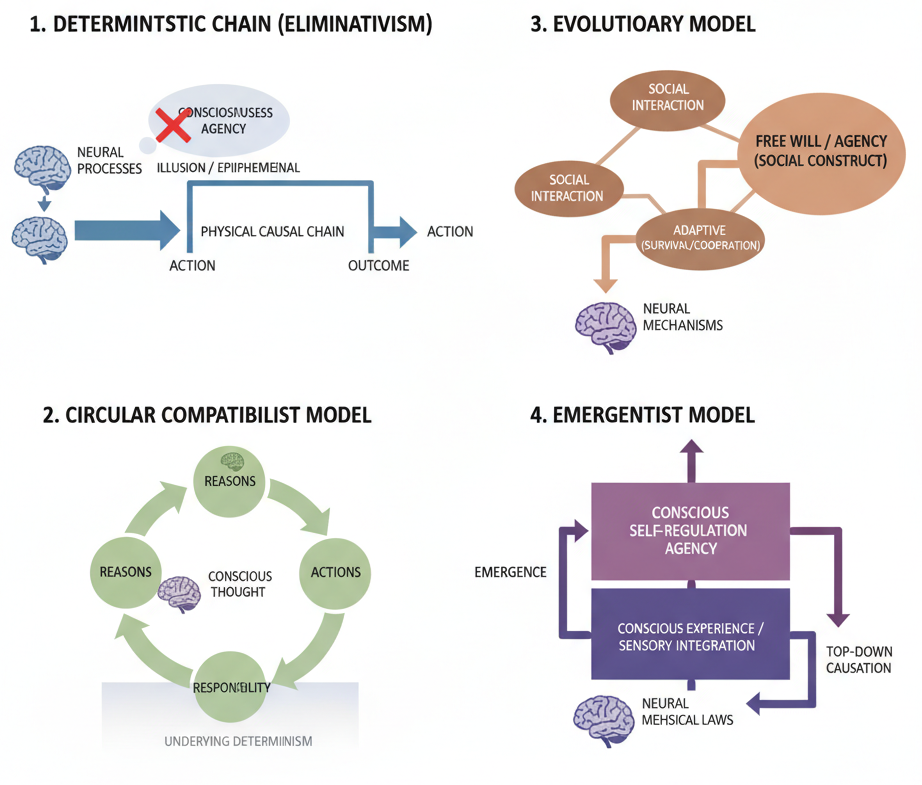
Eliminativist perspectives hold that concepts such as free will, moral responsibility, or even intention may be folk psychological constructs that neuroscience will ultimately render obsolete. Rooted in the philosophy of mind advanced by Churchland and others, eliminativism argues that as our understanding of the brain deepens, we will discard outdated notions in the same way that alchemy was replaced by chemistry.
From this view, the readiness potential experiments and predictive neuroimaging studies suggest that conscious will plays no causal role in generating action. If the brain initiates decisions unconsciously, then free will is a retrospective illusion. The apparent sense of agency is merely a byproduct of the brain constructing a narrative to make sense of its own activity (Wegner, 2002).
Eliminativism thus converges with hard determinism: every action is the necessary outcome of prior neural and environmental causes. In this framework, responsibility becomes an outdated concept. Instead of asking whether individuals deserve punishment, society should focus on causal explanations and pragmatic interventions, such as rehabilitation or prevention.
However, eliminativism faces challenges. It risks collapsing the distinction between trivial motor actions (e.g., button presses) and complex deliberations involving values, morality, and foresight. Moreover, as critics point out, eliminating free will from our conceptual vocabulary may undermine social cohesion, law, and personal identity.
4.2 Compatibilism
Compatibilist approaches, by contrast, seek to reconcile determinism with meaningful freedom. This view, championed by philosophers such as Daniel Dennett, redefines free will not as absolute independence from causation but as the capacity to act in accordance with one's reasons, desires, and values.
From a neurophilosophical standpoint, compatibilism emphasizes that agency emerges from complex, multi-level systems. Even if neural processes are determined, they can still give rise to higher-order structures that count as "free" in a functional sense. For instance, when the prefrontal cortex integrates competing motives, weighing short-term impulses against long-term goals, the resulting decision reflects agency---even if it arises from causal neural mechanisms.
Dennett (2003) argues that free will is best understood as a naturalistic competence: the evolved ability to anticipate consequences, deliberate, and regulate behavior in ways that support social cooperation. Neuroscience, rather than undermining this capacity, helps explain how it arises from biological systems.
Compatibilism is attractive because it preserves responsibility while avoiding metaphysical libertarianism. It also aligns with evidence that conscious control plays a role in vetoing, modulating, or amplifying neural impulses. Even if unconscious processes precede awareness, conscious deliberation still shapes the trajectory of actions in meaningful ways.
4.3 Pragmatic and Evolutionary Models
Another neurophilosophical perspective emphasizes the pragmatic and evolutionary utility of free will. William James anticipated this approach when he argued that belief in free will fosters responsibility and motivation. Contemporary thinkers expand this idea by linking free will to adaptive advantages in social evolution.
From this standpoint, free will need not exist as a metaphysical reality to play a functional role. The sense of agency may be an evolved construct that promotes accountability, cooperation, and moral order. Neuroscience suggests that the brain generates an illusion of volition, but this illusion has practical benefits. Much like consciousness itself, the subjective sense of agency may have adaptive value, even if its ontological status is contested.
Some models propose that free will is best understood as a spectrum of agency rather than a binary property. Degrees of agency depend on cognitive capacities, neural integrity, and social context. For instance, a child, a person with schizophrenia, and a neurologically healthy adult may each exhibit different levels of agency. This spectrum model aligns with neuroscientific evidence of variability in control, while also preserving a framework for responsibility that is flexible rather than absolute.
4.4 Consciousness and Volition
One of the most contentious issues in neurophilosophy is the role of consciousness in volition. Libet's experiments suggest that consciousness lags behind neural initiation, but this does not mean consciousness is causally inert. Several models propose that consciousness serves as a modulatory function, allowing humans to monitor, veto, and integrate actions into coherent plans.
Moreover, consciousness enables counterfactual reasoning---the ability to imagine alternative futures and act accordingly. This capacity distinguishes humans from simple mechanistic systems. Even if unconscious neural activity constrains options, consciousness allows for the flexible orchestration of behavior in light of goals and values.
Some neurophilosophers argue that consciousness is not an illusion but an emergent property of distributed brain processes. While emergent properties remain grounded in physical causation, they exhibit novel dynamics that cannot be reduced to individual neural firings. In this view, free will exists not as uncaused causation but as emergent self-regulation.
Table 3. Neurophilosophical Approaches to Free Will
| Approach | Key Idea | Strengths | Weaknesses |
|---|---|---|---|
| Eliminativism / Hard Determinism | Free will is an illusion; actions are fully determined by neural processes | Empirically grounded; explains unconscious initiation | Undermines responsibility; risks social/legal collapse |
| Compatibilism | Freedom = acting in line with reasons and values within causal systems | Preserves responsibility; fits neuroscience of deliberation | May redefine free will too modestly |
| Pragmatic / Evolutionary | Free will as adaptive construct for cooperation and accountability | Explains social utility; aligns with evolutionary psychology | Treats free will as functional illusion, not reality |
| Emergentist Consciousness | Free will as emergent property of conscious modulation and self-regulation | Integrates neuroscience with phenomenology; spectrum model | Still struggles with determinism at lower levels |
5. Contemporary Challenges
The neurophilosophical debate over free will is no longer confined to laboratories and philosophical treatises. In the 21st century, new technologies and social developments raise pressing questions about agency, responsibility, and autonomy. From artificial intelligence to neurotechnology and legal reform, the challenge is not simply whether free will exists, but how evolving scientific and technological landscapes reshape the very meaning of human agency.
5.1 Artificial Intelligence and Predictive Systems
The rise of artificial intelligence (AI) introduces novel challenges to the concept of free will. Advanced machine learning systems, particularly in predictive analytics, can anticipate human behavior with growing accuracy. Algorithms already predict consumer choices, voting patterns, and even potential criminal behavior. This predictive power echoes neuroscientific findings that unconscious brain activity precedes conscious intention.
If AI can reliably forecast decisions, questions arise about whether human behavior is as autonomous as we believe. Are individuals still free when their actions can be modeled and predicted with statistical precision? Some argue that predictive AI highlights the deterministic structure of choice, reducing freedom to a calculable function. Others suggest that prediction does not negate freedom, since free will may coexist with probabilistic patterns, much as compatibilists argue that determinism and autonomy are not mutually exclusive.
An additional issue is moral agency in AI systems themselves. As AI takes on decision-making roles in medicine, warfare, and governance, scholars debate whether artificial systems can be said to exercise agency. Current consensus denies AI genuine free will, since its outputs are programmed or emergent from algorithmic structures rather than conscious deliberation. Yet the comparison between human and machine decision-making deepens the philosophical inquiry: if humans and AI both follow deterministic rules, what uniquely grounds human freedom?
5.2 Neurotechnology and Cognitive Liberty
Neurotechnology---brain-computer interfaces (BCIs), neural implants, and neurostimulation---poses another challenge. BCIs allow direct communication between the brain and external devices, while technologies such as deep brain stimulation (DBS) can alter mood, behavior, and decision-making.
These interventions raise concerns about cognitive liberty, the right to mental privacy and self-determination. If neural activity can be externally monitored, decoded, or manipulated, the boundary between voluntary agency and external control blurs. A patient whose depression is alleviated by DBS may feel more autonomous, yet also dependent on external modulation. Similarly, BCIs enabling paralyzed individuals to move robotic limbs expand freedom in one sense but highlight the technological mediation of agency.
The possibility of "neuroenhancement" adds further complexity. If individuals enhance cognitive functions or regulate impulses through neural implants, are their decisions more free---because they better align with their goals---or less free, because they depend on artificial aids? These questions mirror long-standing debates about pharmacological interventions but are intensified by the intimacy of neurotechnology with the neural substrates of agency itself.
5.3 Legal Responsibility in the Age of Neuroscience
Perhaps the most socially urgent challenge concerns law and responsibility. Neuroscientific evidence increasingly enters courtrooms, where defense attorneys argue that brain abnormalities, tumors, or traumatic injuries undermine defendants' capacity for free will.
For example, cases of orbitofrontal tumors leading to compulsive or criminal behavior highlight how neural pathology can impair self-control. Courts struggle with whether such defendants are culpable or whether responsibility should be mitigated.
Neuroimaging evidence complicates the law's reliance on mens rea---the "guilty mind" requirement for criminal liability. If unconscious brain activity precedes conscious intention, does this undermine culpability? Some legal scholars worry about the "neuroexculpation" trend, where defendants increasingly appeal to brain scans as evidence of diminished agency.
On the other hand, neuroscience can strengthen responsibility by demonstrating preserved decision-making capacities despite neural impairment. Moreover, compatibilist interpretations suggest that responsibility does not require metaphysical freedom but functional capacities: the ability to deliberate, foresee consequences, and regulate behavior.
The challenge for law is to integrate neuroscientific insights without eroding the normative foundations of justice. A balance must be struck between acknowledging biological constraints and preserving accountability as a social necessity.
5.4 Social and Ethical Implications
Beyond law and medicine, the free will debate has broad ethical implications. If neuroscience and technology increasingly suggest that free will is constrained or illusory, this could erode practices of blame and praise that underlie moral life. Some worry about a "responsibility gap," where individuals disclaim accountability by appealing to their brains or algorithms.
At the same time, rethinking free will could foster more humane systems. A deterministic understanding of behavior might shift focus from retribution to rehabilitation, emphasizing causal explanations and social reform. If crime is seen as the product of neural and environmental factors, then solutions may emphasize prevention and treatment rather than punishment.
In education and social policy, recognizing limits to free will could also promote compassion, by highlighting structural and biological influences on behavior. Yet excessive reductionism risks disempowering individuals, leading to fatalism or resignation. The challenge is to find a middle path where human freedom is acknowledged as real but contextual, shaped by biology, society, and culture.
Table 4. Contemporary Challenges to Free Will
| Domain | Challenge | Implications |
|---|---|---|
| Artificial Intelligence | Predictive algorithms model behavior with high accuracy | Raises doubts about autonomy; comparison with human determinism |
| Neurotechnology | BCIs and DBS modulate neural processes | Expands autonomy (e.g., mobility) but blurs line between self and device |
| Legal Responsibility | Neuroscience in court challenges mens rea | Could erode or redefine culpability and justice |
| Ethics & Society | Reductionist accounts risk fatalism | Opportunity to shift toward rehabilitation and compassion |
6. Future Directions and Conclusion
The neurophilosophical debate on free will has traveled a long intellectual journey, from metaphysical speculation in antiquity to empirical investigation in modern neuroscience. Yet the debate remains unresolved. Instead of closure, each stage of the discourse opens new avenues of inquiry. As we look to the future, the challenge is not merely to ask whether free will exists, but to understand how concepts of agency can be meaningfully reinterpreted in light of emerging science and technology.
6.1 Integrating Neuroscience and Philosophy
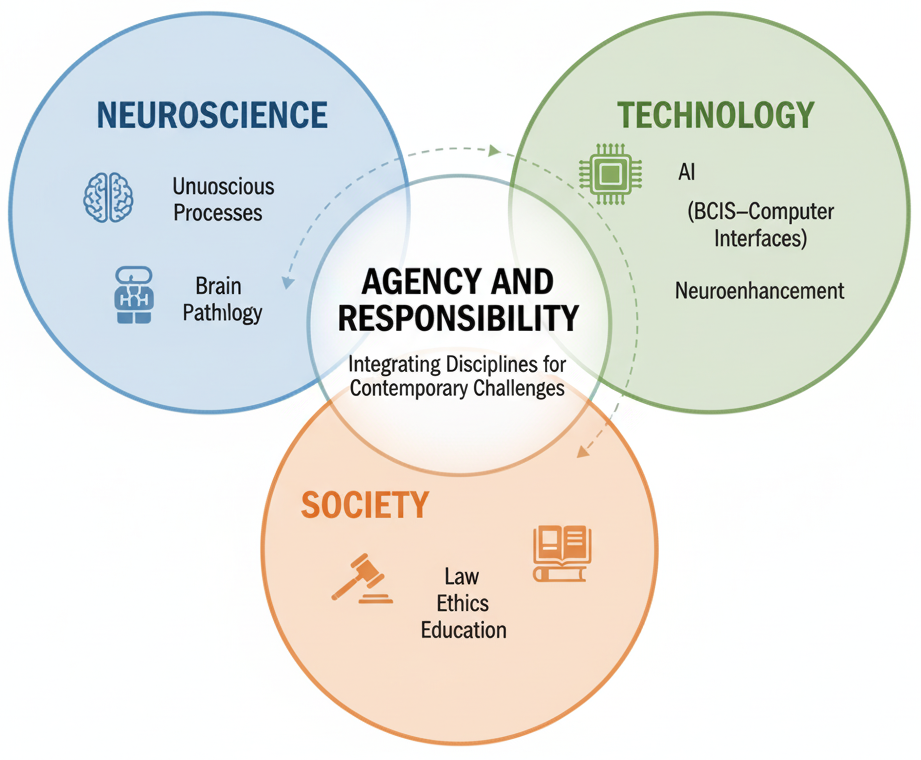
One promising direction is the integration of neuroscience and philosophy into more nuanced frameworks of agency. Rather than treating philosophy as speculative and neuroscience as decisive, future scholarship may emphasize their complementarity. Neuroscience provides data about unconscious processes, neural correlates of decision-making, and mechanisms of self-control. Philosophy, in turn, provides interpretive models that clarify the normative and conceptual significance of such findings.
For example, compatibilist frameworks may evolve into layered models of agency, where freedom is analyzed at multiple levels---from neural substrates to psychological deliberation to social accountability. Such models could reconcile deterministic causation at the neural level with emergent responsibility at the personal and societal level.
6.2 Expanding Beyond Trivial Tasks
Much of the current empirical debate hinges on experiments involving trivial motor tasks---button presses, wrist flexions, or binary decisions. Future research must expand into more ecologically valid contexts, studying decisions that involve values, emotions, and long-term consequences. Advances in neuroimaging and computational modeling may allow researchers to capture the dynamics of complex decision-making in real-world settings, offering insights more relevant to moral and legal responsibility.
6.3 Neurotechnology and Human Autonomy
As neurotechnology develops, questions about free will will increasingly intersect with issues of cognitive liberty and enhancement. Future directions include ethical frameworks for regulating brain-computer interfaces, ensuring that autonomy is preserved rather than undermined. A critical research area is distinguishing between technologies that expand agency (e.g., restoring motor control in paralysis) and those that risk eroding authenticity by imposing external control.
Scholars may also explore the possibility of neurodiverse models of agency. If different neural profiles (e.g., autism, schizophrenia, or enhancement through implants) produce different patterns of volition, then free will may not be uniform but plural. Such perspectives could reframe responsibility in more inclusive and context-sensitive ways.
6.4 Legal and Ethical Reform
Law and ethics will continue to grapple with the implications of neuroscience. The future may see gradations of responsibility replacing binary judgments of culpability. Just as medicine recognizes spectra of health, law may recognize spectra of agency, tailoring accountability to neurological and psychological capacities.
Ethically, rethinking free will could foster compassionate systems of justice focused on prevention, rehabilitation, and social reform. Yet this must be balanced against the need to preserve accountability. A society that entirely dissolves responsibility risks undermining trust and cooperation. The challenge is to integrate neuroscientific insights without collapsing the normative foundations of ethics and law.
6.5 Artificial Intelligence and the Human Distinction
The rise of AI highlights the urgency of clarifying what distinguishes human agency. As machines become increasingly capable of simulating choice, creativity, and reasoning, free will may serve as a boundary concept that demarcates human uniqueness. Future research may explore whether free will is grounded in consciousness, intentionality, or moral reasoning, and whether these capacities can ever be replicated by machines.
Some futurists speculate about hybrid agency, where humans and AI systems collaborate in decision-making. In such contexts, free will may evolve from an individual property to a relational or distributed phenomenon, embedded in networks of humans, machines, and institutions.
6.6 Philosophical Humility and Interdisciplinary Dialogue
Finally, the future of the free will debate requires philosophical humility and interdisciplinary dialogue. Neuroscience alone cannot resolve normative questions about responsibility, just as philosophy cannot ignore empirical findings. The most fruitful direction may be collaborative, with philosophers, neuroscientists, ethicists, and legal scholars working together to refine concepts of agency that are scientifically informed and socially relevant.
Table 5. Future Directions in Free Will Research
| Domain | Key Development | Implications |
|---|---|---|
| Neuroscience | Move beyond trivial tasks; study complex, value-laden decisions | More ecologically valid insights into agency |
| Philosophy | Layered, compatibilist, or emergent models of freedom | Reconciles determinism with responsibility |
| Neurotechnology | Regulation of BCIs and implants; cognitive liberty | Ensures autonomy while expanding human capacities |
| Law & Ethics | Gradations of responsibility; compassionate justice | Balances accountability with biological realities |
| AI & Society | Clarify distinction between human and machine agency | Defines human uniqueness and future hybrid models |
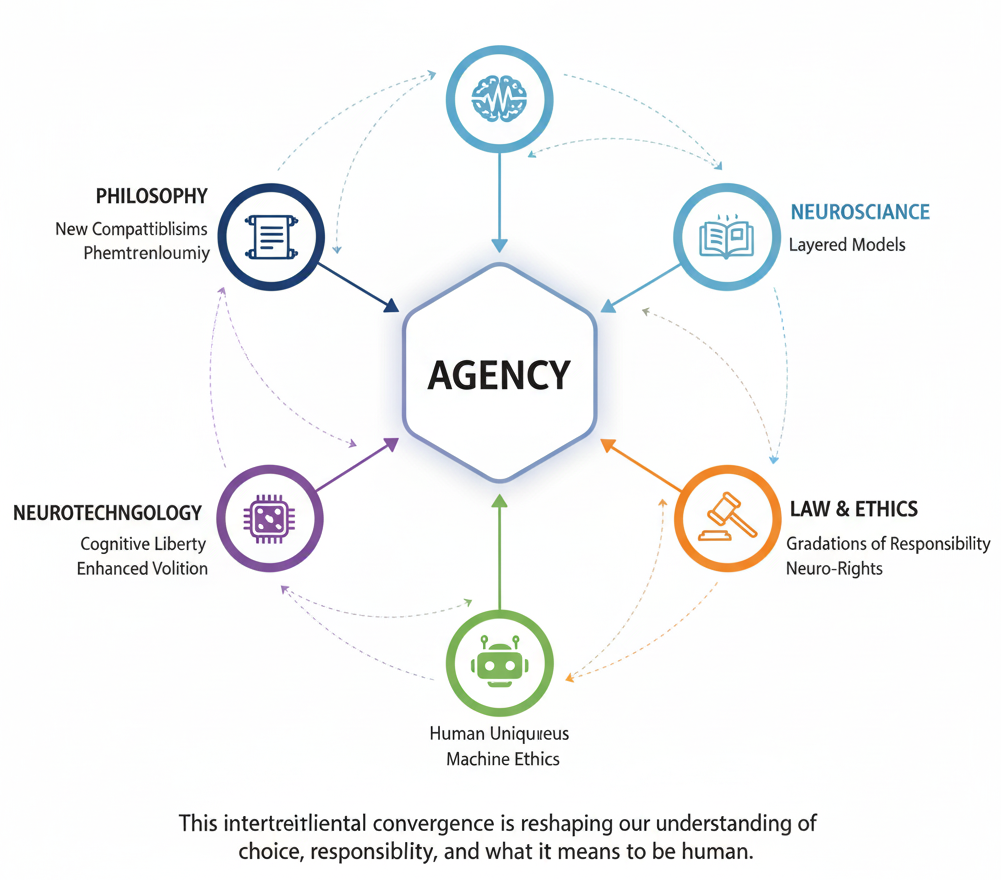
7. Discussion
The intersection of philosophy and neuroscience has profoundly reshaped the free will debate. Historically, philosophers approached free will through metaphysical reasoning, theological commitments, and ethical concerns. Neuroscience, however, grounds the discussion in empirical data---brain imaging, electrophysiological signals, and computational modeling. The challenge is not to replace philosophy with science, but to synthesize insights from both domains into a coherent framework that respects empirical findings while preserving normative significance.
7.1 Synthesizing Philosophy and Neuroscience
Philosophy provides the conceptual tools to interrogate the meaning of free will, responsibility, and agency, while neuroscience investigates the causal mechanisms underlying decision-making. A synthetic approach acknowledges that readiness potentials, unconscious neural activity, and predictive brain patterns complicate but do not abolish free will. Instead, they invite a shift in emphasis: from free will as an uncaused metaphysical property to free will as a multi-level capacity embedded in neural, psychological, and social systems.
Compatibilist and emergentist frameworks demonstrate the value of synthesis. From philosophy, we inherit the insight that freedom concerns the ability to deliberate and act according to reasons. From neuroscience, we learn that these processes are constrained by unconscious neural mechanisms. Together, these insights suggest that free will should be reconceived not as absolute independence, but as the capacity of conscious systems to modulate and contextualize unconscious impulses.
7.2 Free Will as an Emergent Phenomenon
One of the most promising directions is to interpret free will as an emergent phenomenon. At the micro-level, neural firings obey deterministic or probabilistic laws. Yet at the macro-level, new properties emerge---such as consciousness, intentionality, and reflective self-regulation. These emergent capacities allow individuals to weigh alternatives, anticipate consequences, and adjust behavior in light of goals and values.
Emergence does not imply metaphysical dualism. Instead, it reflects the principle that higher-order phenomena can display novel properties not reducible to their parts. Just as liquidity emerges from molecular interactions without being a property of any single molecule, free will may emerge from neural processes without being reducible to them.
7.3 Do We Need to Redefine "Agency"?
If free will is emergent, should we redefine "agency"? Traditional definitions often assume an all-or-nothing property: either actions are free or determined. Neuroscience complicates this binary. Agency may be better understood as a spectrum shaped by cognitive capacities, neural integrity, and environmental factors. For example, children, patients with neurological disorders, and healthy adults display different levels of agency, yet all retain some form of responsibility.
Redefining agency in graded terms allows us to preserve the relevance of free will without succumbing to fatalism. It also aligns with social practices, such as tailoring legal responsibility to mental competence or adjusting moral expectations according to developmental stage. In this sense, redefining agency is not a concession but a refinement---making the concept more accurate, humane, and empirically grounded.
7.4 Limitations of Current Research
Despite advances, neuroscience of free will faces significant limitations. First, most experimental paradigms rely on artificial tasks (e.g., pressing a button), which may not reflect real-world decision-making. Second, measuring the timing of intention remains imprecise, as subjective reports (W-time) are prone to error. Third, predictive models achieve above-chance accuracy but fall far short of determinism, leaving ample room for stochasticity and higher-order modulation.
Additionally, the ethical interpretation of findings is often contested. Even if unconscious processes precede awareness, it does not follow that conscious control is irrelevant. Studies showing "free won't" suggest that consciousness plays a critical veto role, which remains underexplored. Finally, most research is conducted in laboratory conditions with limited generalizability across cultures, contexts, and moral domains.
8. Conclusion
The debate over free will is far from settled, but contemporary neurophilosophy offers fresh perspectives that integrate empirical findings with philosophical reflection.
Historical analysis reveals that free will has always been contested, oscillating between libertarianism, determinism, and compatibilism. Neuroscience has added empirical depth by demonstrating that unconscious neural activity precedes conscious awareness. Yet these findings do not conclusively refute free will; instead, they challenge simplistic models of agency.
Philosophical synthesis shows that free will is not an all-or-nothing property. Rather, it exists on a spectrum that ranges from diminished capacity (as in neurological disorders) to robust autonomy (as in reflective moral agents). Emergentist models capture this complexity by situating agency at higher levels of self-regulation and conscious deliberation, even within a causally determined framework.
NeuroPhilosophy serves as a bridge between empirical and normative domains. Neuroscience provides evidence of unconscious constraints, while philosophy ensures that concepts such as responsibility, dignity, and justice remain central. This dual perspective prevents reductionism and safeguards the ethical relevance of free will in law, medicine, and society.
Looking ahead, the study of free will must embrace interdisciplinary integration. Neuroscience should expand beyond trivial tasks to real-world contexts. AI challenges us to clarify what distinguishes human agency, while neurotechnology raises urgent questions about cognitive liberty. Law and ethics must adapt by adopting more flexible, spectrum-based models of responsibility.
Ultimately, free will remains indispensable---not as a metaphysical absolute, but as a practical and normative framework that structures human life. In an age of neuroscience and AI, defending a nuanced, emergent conception of agency ensures that freedom continues to serve as a foundation for justice, responsibility, and human dignity.
References
- Aharoni E, Vincent G, Harenski C, Calhoun V, Sinnott-Armstrong W, Gazzaniga M, Kiehl KA. Neuroprediction of future rearrest. Proceedings of the National Academy of Sciences USA 2013; 110(15): 6223–6228. doi:10.1073/pnas.1306203110
- Appelbaum PS, Scurich N. Neuroscience in the courtroom. Annual Review of Law and Social Science 2014; 10: 173–195.
- Aristotle. Nicomachean Ethics. Hackett Publishing, 1999.
- Augustine. The Free Choice of the Will. Hackett Publishing, 1998.
- Aquinas T. Summa Theologica. Christian Classics, 1981. (Original work 1274)
- Bostrom N. Superintelligence: Paths, Dangers, Strategies. Oxford: Oxford University Press, 2014.
- Brass M, Haggard P. To do or not to do: The neural signature of self-control. Journal of Neuroscience 2007; 27(34): 9141–9145. doi:10.1523/JNEUROSCI.0924-07.2007
- Bublitz JC, Merkel R. Crimes against minds: On mental manipulations and the right to mental self-determination. Criminal Law and Philosophy 2014; 8(1): 51–77.
- Churchland PM. A Neurocomputational Perspective: The Nature of Mind and the Structure of Science. MIT Press, 1989.
- Churchland PS. Neurophilosophy: Towards a Unified Understanding of the Mind/Brain. MIT Press, 1986.
- Churchland PS. Exploring the causal underpinning of determination, resolve, and will. Neuron 2013; 80: 1337–1338.
- Dennett DC. Freedom Evolves. Viking, 2003.
- Descartes R. Meditations on First Philosophy. Cambridge: Cambridge University Press, 1996. (Original 1641)
- Douglas T. Neurointerventions and state violence. Journal of Applied Philosophy 2008; 25(3): 279–293.
- Earp BD, Savulescu J. Moral enhancement and free will. Neuroethics 2014; 7(2): 107–118.
- Farah MJ. Neuroethics: An Introduction with Readings. MIT Press, 2014.
- FitzGerald THB, Dolan RJ, Friston K. Dopamine, reward learning, and active inference. Frontiers in Computational Neuroscience 2015; 9: 136. doi:10.3389/fncom.2015.00136
- Frankfurt HG. Alternate Possibilities and Moral Responsibility. Journal of Philosophy 1969; 66(23): 829–839.
- Freud S. The unconscious. In Strachey J (Ed.). The Standard Edition of the Complete Psychological Works of Sigmund Freud. Hogarth Press, 1957.
- Gazzaniga MS. Who's in Charge? Free Will and the Science of the Brain. Ecco, 2011.
- Gazzaniga MS, Churchland PS (Eds.). The Cognitive Neurosciences (5th ed.). MIT Press, 2018.
- Glannon W. Bioethics and the Brain. Oxford: Oxford University Press, 2006.
- Greely H, Sahakian B, Harris J, Kessler R C, Gazzaniga M, Campbell P, Farah M. Toward responsible use of cognitive-enhancing drugs by the healthy. Nature 2008; 456(7223): 702–705.
- Greene J, Cohen J. For the law, neuroscience changes nothing and everything. Philosophical Transactions of the Royal Society B 2004; 359(1451): 1775–1785.
- Haggard P. Human volition: Towards a neuroscience of will. Nature Reviews Neuroscience 2008; 9: 934–946.
- Haggard P, Eimer M. On the relation between brain potentials and the awareness of voluntary movements. Experimental Brain Research 1999; 126(1): 128–133.
- Haynes JD. Decoding and predicting intentions. Annals of the New York Academy of Sciences 2011; 1224(1): 9–21. doi:10.1111/j.1749-6632.2011.05994.x
- Illes J (Ed.). Neuroethics: Defining the Issues in Theory, Practice, and Policy. Oxford University Press, 2006.
- Kane R. The Significance of Free Will. Oxford: Oxford University Press, 1996.
- Kant I. Critique of Practical Reason. Cambridge: Cambridge University Press, 1997. (Original 1788)
- Lavazza A, Inglese S. Free will, neuroscience and responsibilities. Frontiers in Psychology 2015; 6: 1884.
- Levy N. Neuroethics: Challenges for the 21st Century. Cambridge: Cambridge University Press, 2011.
- Libet B, Gleason CA, Wright EW, Pearl DK. Time of conscious intention to act in relation to onset of cerebral activity. Brain 1983; 106(3): 623–642. doi:10.1093/brain/106.3.623
- Libet B. Mind Time: The Temporal Factor in Consciousness. Harvard University Press, 2004.
- Matsuhashi M, Hallett M. The timing of the conscious intention to move. European Journal of Neuroscience 2008; 28(11): 2344–2351. doi:10.1111/j.1460-9568.2008.06525.x
- Mele AR. Effective Intentions: The Power of Conscious Will. Oxford: Oxford University Press, 2009.
- Morse SJ. Brain overclaim syndrome and criminal responsibility. Ohio State Journal of Criminal Law 2006; 3: 397–412.
- Morse SJ, Roskies A (Eds.). Neurolaw: When Neuroscience Meets the Law. Oxford University Press, 2013.
- Nahmias E. Intuitions about free will and responsibility: Expanding the empirical foundation. Philosophy Compass 2014; 9(3): 142–150.
- Nichols S. Sentimental Rules: On the Natural Foundations of Moral Judgment. Oxford: Oxford University Press, 2004.
- O'Connor T. Persons and Causes: The Metaphysics of Free Will. Cambridge University Press, 2000.
- Parvizi J, Damasio A. Neuroanatomy of will and volition. In Gazzaniga M (Ed.). The Cognitive Neurosciences (4th ed.). MIT Press, 2009.
- Poldrack RA. Can cognitive processes be inferred from neuroimaging data? Trends in Cognitive Sciences 2006; 10(2): 59–63.
- Panksepp J. Affective Neuroscience: The Foundations of Human and Animal Emotions. Oxford University Press, 1998.
- Patel R. Law and Neuroscience: Current Issues and Applications. Routledge, 2016.
- Pacherie E. The phenomenology of action: A conceptual framework. Cognition 2008; 107(2): 179–217.
- Pinker S. The Blank Slate: The Modern Denial of Human Nature. Viking, 2002.
- Roskies AL. Neuroscientific challenges to free will and responsibility. Trends in Cognitive Sciences 2006; 10(9): 419–423. doi:10.1016/j.tics.2006.07.003
- Roskies AL. Beyond the Brain: Neuroscience and Society. Columbia University Press, 2012.
- Roskies AL. Neuroethics and the law: Neuroscience, responsibility, and the legal mind. Annual Review of Law and Social Science 2015; 11: 17–36.
- Shadlen MN, Roskies A. The neurobiology of decision making and responsibility. Philosophical Transactions of the Royal Society B 2012; 367: 119–128.
- Schurger A, Sitt JD, Dehaene S. An accumulator model for spontaneous neural activity prior to self-initiated movement. Proceedings of the National Academy of Sciences USA 2012; 109(42): E2904–E2913. doi:10.1073/pnas.1210467109
- Soon CS, Brass M, Heinze HJ, Haynes JD. Unconscious determinants of free decisions in the human brain. Nature Neuroscience 2008; 11(5): 543–545. doi:10.1038/nn.2112
- Tremblay L, Schultz W. The neurobiology of decision making. Annual Review of Neuroscience 2000; 23: 1–25.
- Vohs KD, Schooler JW. The value of believing in free will: Encouraging a belief in determinism increases cheating. Psychological Science 2008; 19(1): 49–54.
- Wallach W, Allen C. Moral Machines: Teaching Robots Right from Wrong. Oxford University Press, 2009.
- Wegner DM. The Illusion of Conscious Will. MIT Press, 2002.
- Wittgenstein L. Philosophical Investigations. Blackwell, 1953.
- Wang Y, Li H, et al. Predictive neural patterns in real-world decision contexts. Journal of Cognitive Neuroscience 2022; 34(7): 1652–1668.
- Yuste R, Goering S, Arcas B, Bi G, Carmena JM, Carter A, Fins JJ, et al. Four ethical priorities for neurotechnology and AI. Nature 2021; 591: 91–93. doi:10.1038/d41586-021-00531-y
- Zeki S. A Vision of the Brain. Blackwell, 1998.
Authors hold copyright with no restrictions. This work is licensed under CC BY.